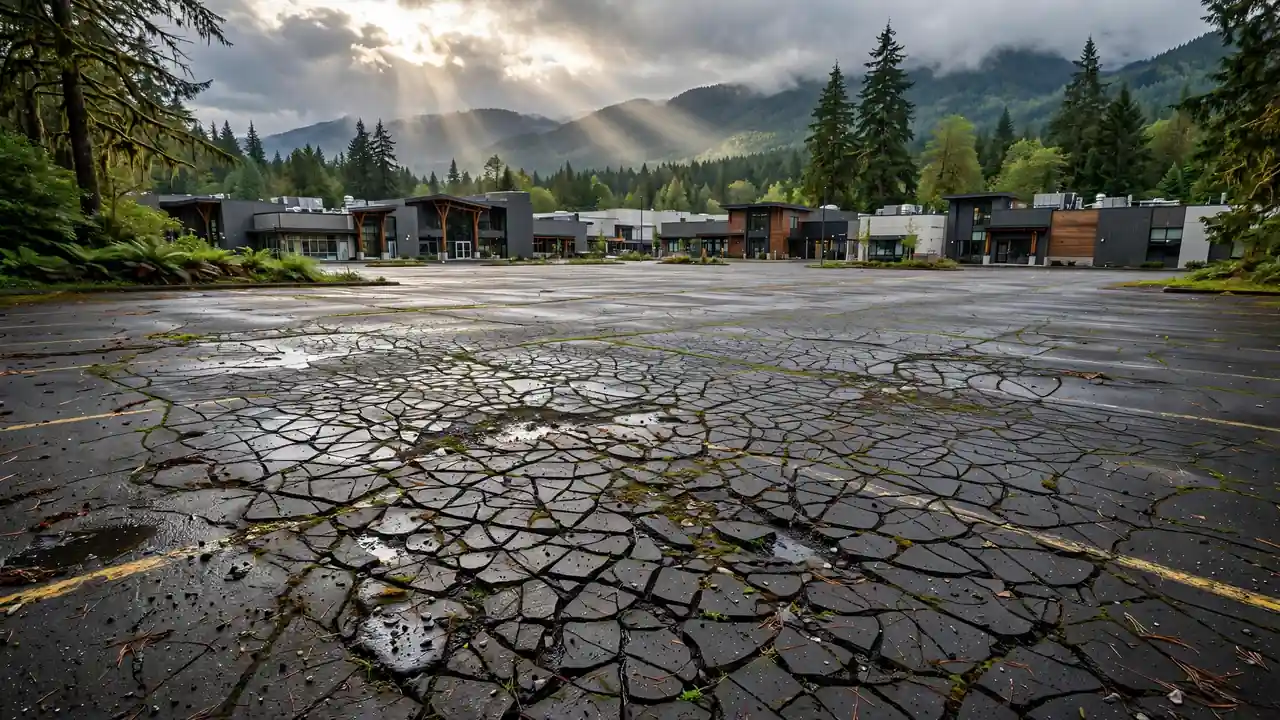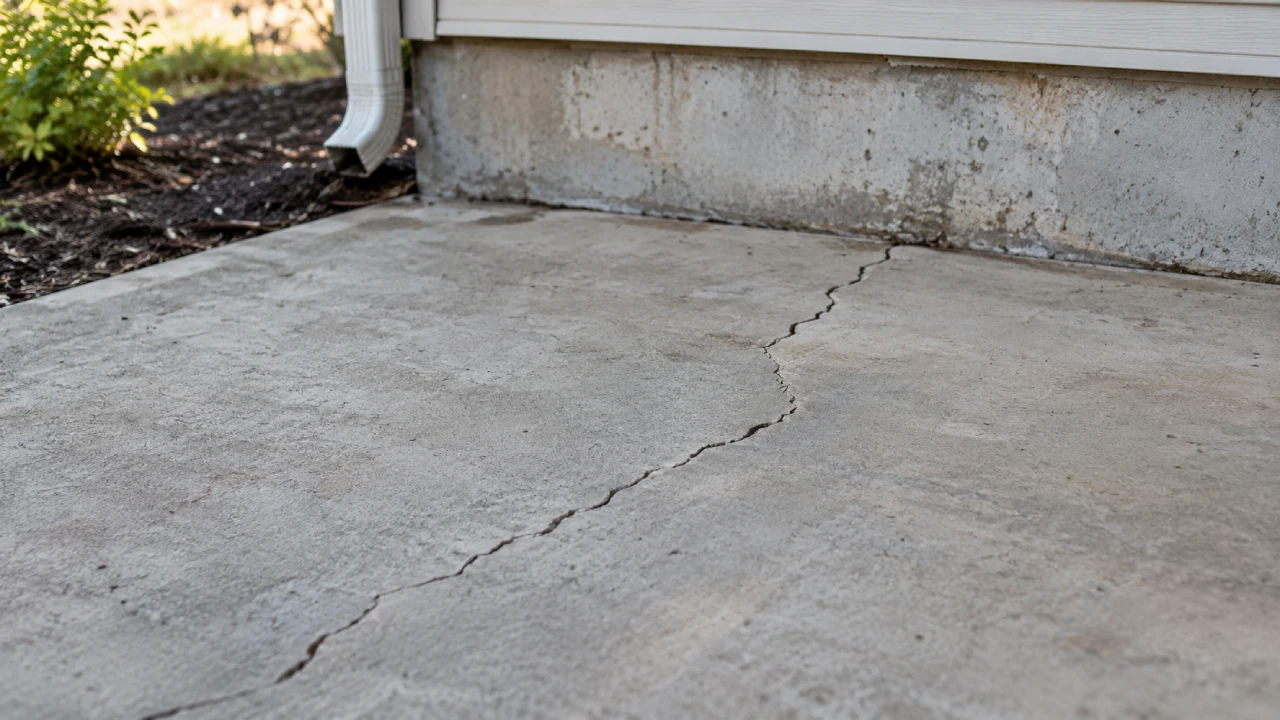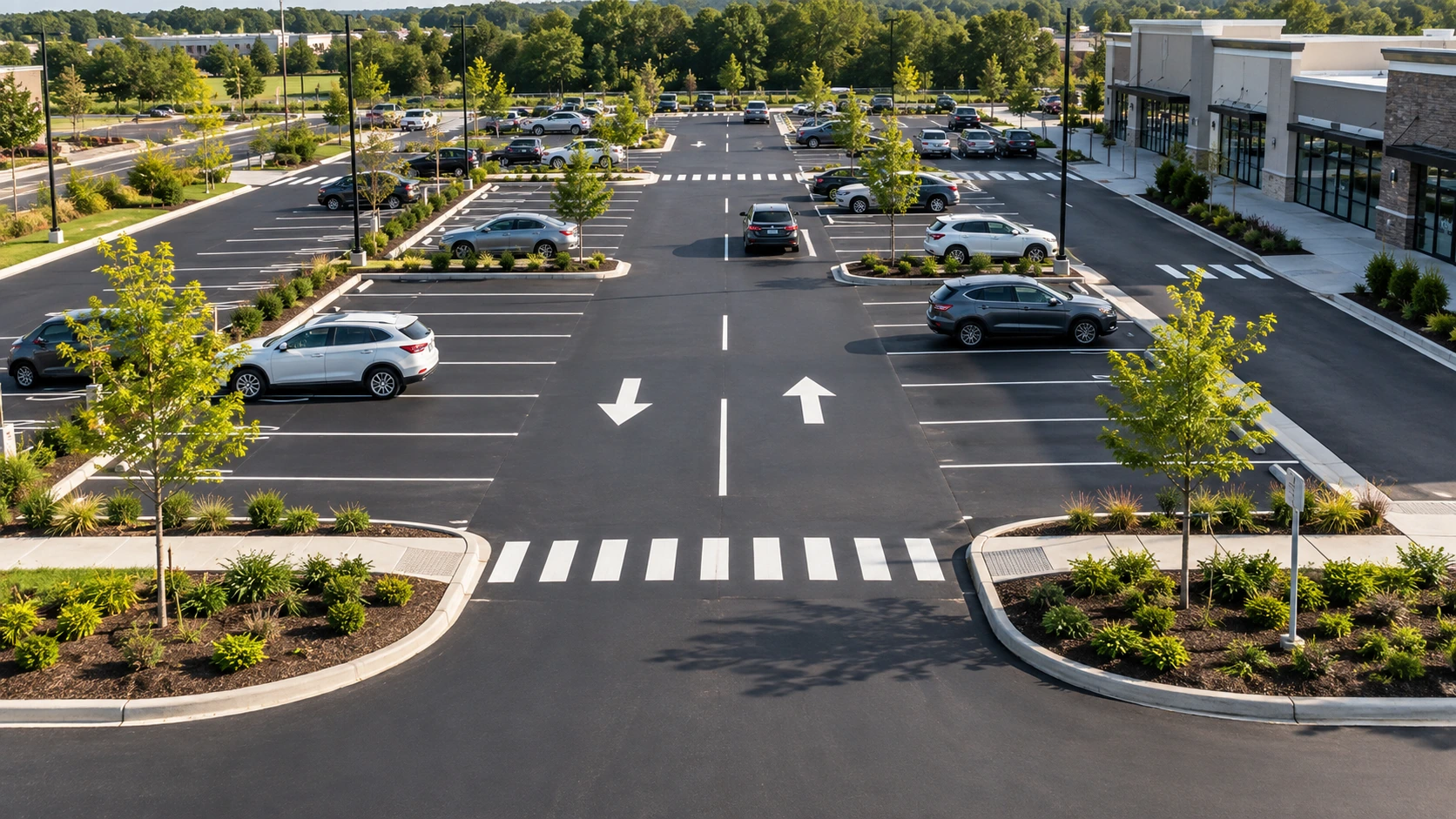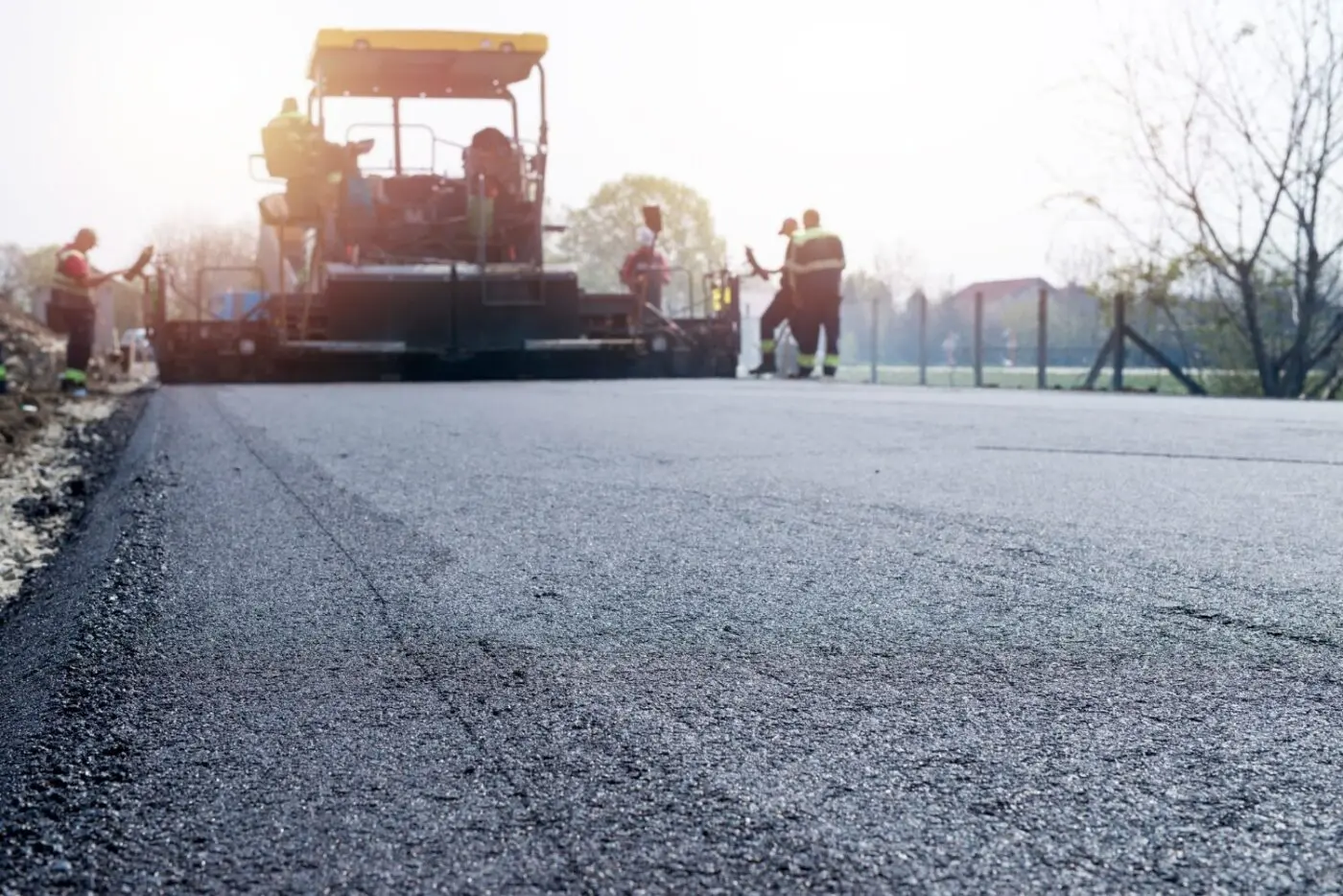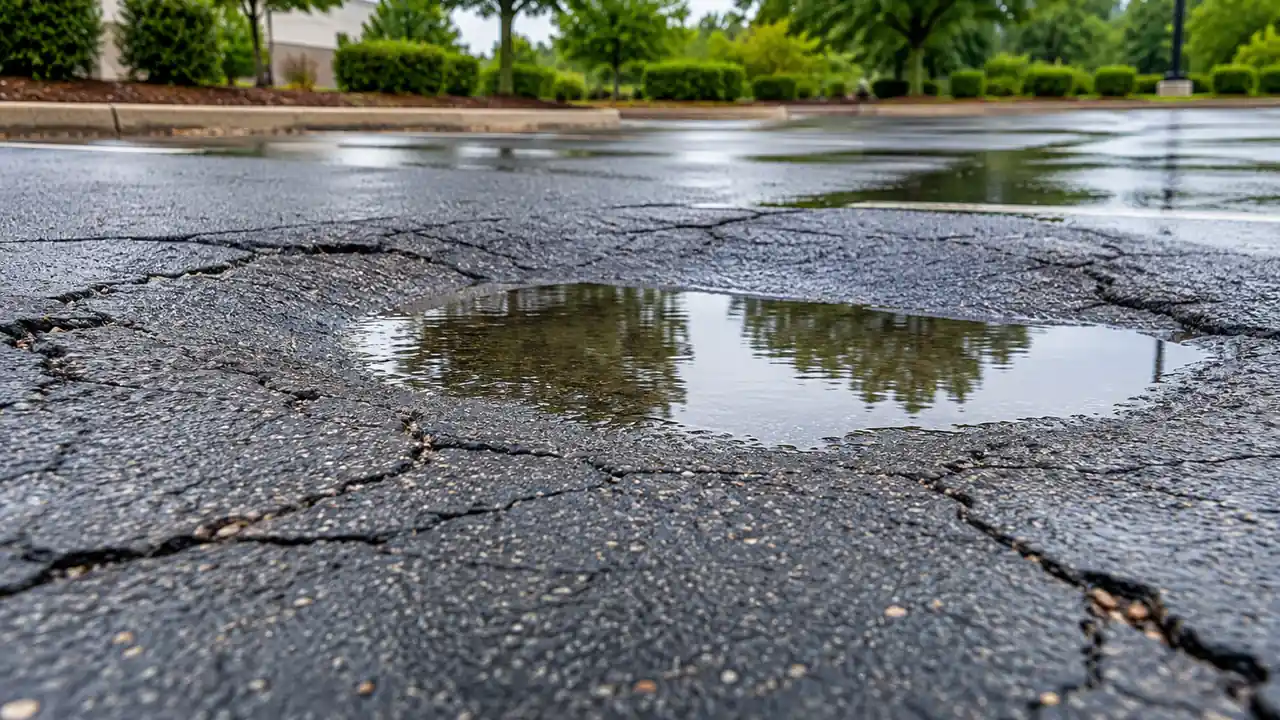
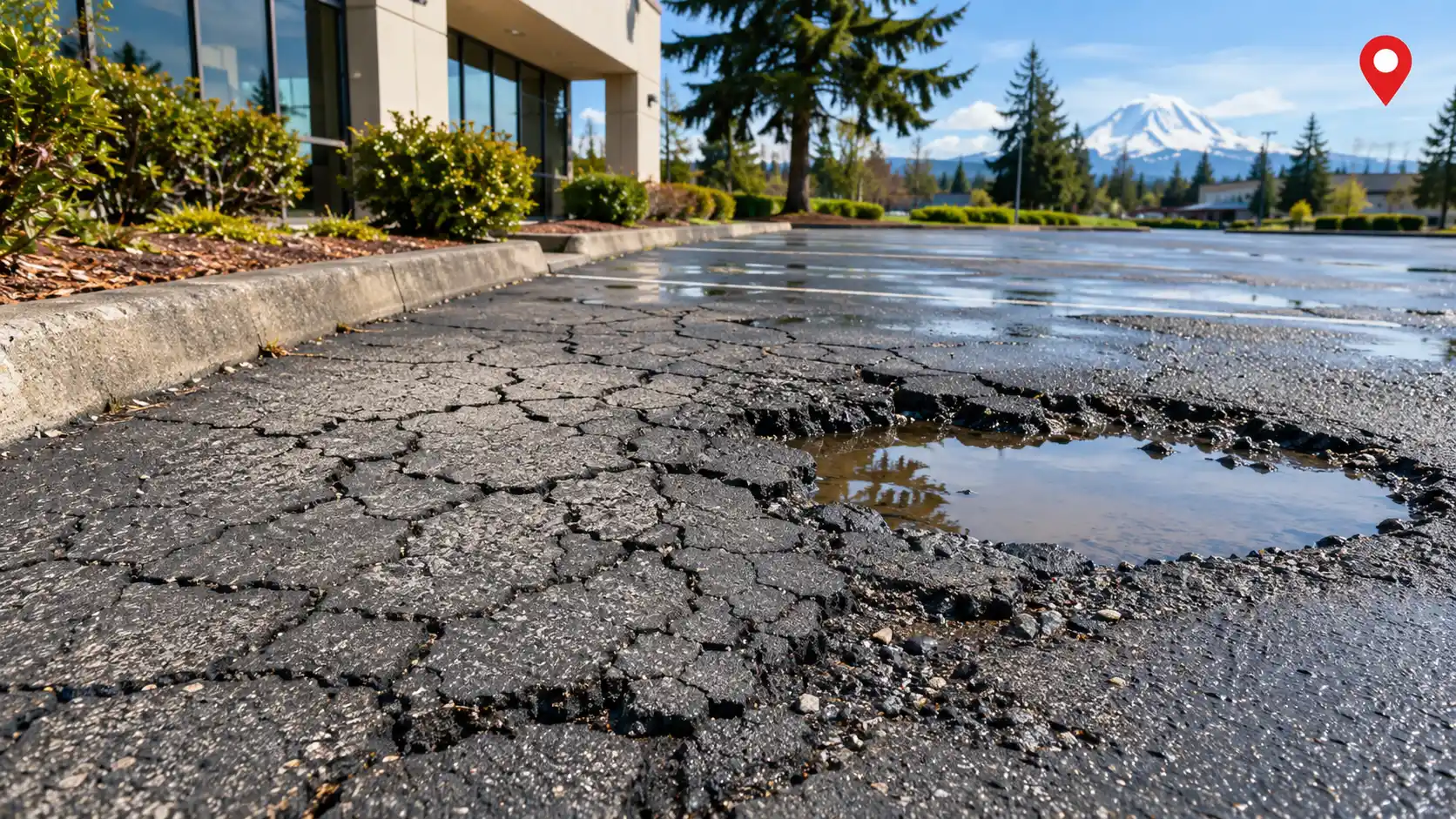
Asphalt base failure signs often appear as interconnected cracks, sinking pavement, recurring potholes, deep wheel path depressions, and areas that continue deteriorating despite previous repairs. These symptoms may indicate that the pavement’s supporting layers are no longer providing adequate support.
However, not every crack or depression means the base has failed. Some problems originate in the asphalt surface, while others involve the aggregate base, underlying soil, drainage, or a combination of conditions.
That distinction matters because the correct repair depends on how deeply the damage extends.
A parking lot may look worn but still have a sound foundation. Another may appear relatively intact until a loaded delivery truck crosses a weakened section and causes additional movement.
For property owners, facility managers, commercial operators, and homeowners in Kent and the greater Puget Sound region, recognizing possible asphalt base failure signs early can help avoid unnecessary resurfacing and identify areas requiring structural repair.
This guide explains what to look for, how to distinguish surface deterioration from possible foundation instability, and what should happen before choosing between patching, resurfacing, and reconstruction.
Table of Contents
-
Understanding What Lies Beneath Asphalt
-
Seven Asphalt Base Failure Signs
-
Why Asphalt Foundations Lose Support
-
How to Distinguish Surface Damage From Base Failure
-
A Practical Pavement Inspection Checklist
-
How Professionals Investigate Hidden Damage
-
Choosing Between Patching, Overlays, and Reconstruction
-
When Surface Treatments Are Not Enough
-
Understanding the Cost of Base Repairs
-
Preventing the Same Failure From Returning
-
Questions Property Owners Commonly Ask
-
Planning the Right Pavement Repair
Understanding What Lies Beneath Asphalt
Before interpreting asphalt base failure signs, it helps to understand how pavement carries vehicle loads.
An asphalt driveway or parking lot is more than the dark surface people drive across. It is a system of materials that must work together to support traffic and withstand environmental conditions.
The asphalt surface distributes traffic loads
The visible asphalt layer provides a driving surface and contributes structural strength.
Its performance depends on the asphalt mixture, layer thickness, construction quality, temperature conditions, and traffic loads.
When vehicles pass over pavement, stress is transmitted through the asphalt into the supporting materials.
A structurally sound surface helps distribute those forces. If the material underneath cannot support the load, excessive bending or deformation may occur.
The aggregate base provides additional support
Beneath the asphalt is often a compacted aggregate base, which may include crushed stone or other specified granular material.
This layer helps distribute traffic loads and provides a stable working platform.
Its performance depends on several conditions, including material quality, thickness, compaction, moisture, and support from the soil below.
A properly constructed aggregate base can still develop problems if water, erosion, settlement, or changing loads alter its condition.
The subgrade is the soil beneath the pavement
The subgrade is the underlying soil supporting the pavement structure.
Its strength can vary considerably across a property.
One section may have firm, well-compacted soil, while another contains weaker fill, moisture-sensitive material, or soil disturbed by previous construction.
A pavement structure can become unstable even when the asphalt and aggregate were originally installed correctly.
This is why civil site work, grading, and proper foundation preparation matter before paving begins.
The key distinction: Base failure and subgrade failure are related but not identical. A damaged aggregate base, weak subgrade, inadequate asphalt thickness, or another structural problem can produce similar surface symptoms. The cause must be investigated rather than assumed.
7 Asphalt Base Failure Signs You Should Never Ignore
The strongest evidence of a structural pavement problem usually comes from several symptoms appearing together.
One isolated crack might justify maintenance. Interconnected cracking combined with settlement, water movement, or repeated patch failure warrants closer investigation.
1. Alligator cracking that spreads across wheel paths
Alligator cracking is one of the most recognizable asphalt distress patterns.
It appears as interconnected cracks forming small, irregular shapes resembling reptile skin.
These cracks often develop in areas subjected to repeated vehicle loads.
According to the Federal Highway Administration’s pavement distress guidance, fatigue cracking can progress from a few connected cracks into a broader network of broken pavement. At more severe stages, fragments may move under traffic, and pumping may be present.
Why it raises concern
Repeated loading can cause pavement layers to flex and deteriorate. That deterioration may be associated with inadequate support, structural capacity, or other material problems.
For example, imagine a warehouse entrance where delivery trucks repeatedly follow the same path.
Initially, a few narrow cracks appear.
Over time, those cracks connect and the asphalt begins breaking into smaller sections.
If the area also sinks or moves under traffic, the evidence for a deeper structural issue becomes stronger.
However, alligator cracking does not automatically prove that the aggregate base itself has failed.
A professional evaluation should determine which pavement layers require attention.
For a more focused explanation of the cracking pattern, see what alligator cracking in asphalt means.
2. Depressed or sinking pavement
A noticeable dip in a driveway, parking lot, or roadway can indicate that the pavement is no longer receiving uniform support.
The depression may appear gradually or become noticeable after construction work, repeated loading, or prolonged wet conditions.
Common locations include parking lot entrances, utility trenches, drainage structures, loading zones, and transitions between newer and older pavement.
What should you look for?
Compare the damaged section with the surrounding pavement.
Does the asphalt slope into a depression? Does the low area follow a previous trench? Is a nearby concrete curb still at its original elevation while the asphalt has dropped?
These observations help narrow the possible causes.
For example, imagine a parking lot with a narrow sunken strip running from one curb to another.
If utility work was previously performed along that strip, settlement of trench backfill may be a possibility.
By contrast, a broad depression beneath heavy truck traffic may justify investigating the supporting pavement layers and soil.
The appropriate repair may involve excavation services and replacement of unstable material rather than simply adding asphalt to restore the surface elevation.
3. Potholes that return after repeated repairs
A pothole can develop for several reasons, including deterioration of asphalt material, moisture, repeated loading, and loss of support.
A single pothole does not establish that the base has failed.
The warning becomes more significant when a properly repaired section deteriorates repeatedly.
Imagine a commercial parking lot where the same pothole has been patched several times.
Each repair initially restores the driving surface, but cracks return around the edges, the patch sinks, or loose material begins appearing again.
Possible explanations include:
-
Unstable material remaining beneath the patch.
-
Poor preparation or compaction during repair.
-
Water continuing to enter the pavement structure.
-
Traffic loads exceeding the capacity of the repaired section.
-
Deterioration extending beyond the original patch boundary.
The solution depends on which explanation is supported by the evidence.
A previous repair may also have failed because of workmanship rather than base failure.
Before scheduling another asphalt paving and repair project, ask whether the repair should extend deeper or wider than the damaged surface.
For a more detailed examination, see why recurring pothole repairs keep failing.
4. Deep rutting along vehicle wheel paths
Rutting occurs when permanent depressions develop along the paths traveled by vehicle tires.
The shape may resemble two parallel channels running through a driveway, truck lane, or parking lot entrance.
Rutting can originate within the asphalt mixture, the aggregate base, the subgrade, or several layers together.
That makes the location and shape of the depression important.
A weak asphalt mixture may deform under repeated heavy loading even when its underlying support is adequate.
In other situations, wheel loads may compress or displace weaker material beneath the asphalt.
How can property owners tell the difference?
They generally cannot determine the affected layer from visual inspection alone.
However, they can document whether the rutting is accompanied by cracking, settlement, water accumulation, or surface displacement.
If the ruts are deepening and connected cracks begin forming in the same wheel paths, a structural investigation becomes increasingly important.
The repair should address the layer responsible for the deformation.
For additional detail, read why asphalt develops ruts in wheel paths.
5. Water or fine material emerging through cracks
Water emerging from pavement cracks under loading deserves particular attention.
This behavior may be associated with pumping, where traffic loads force water and fine materials through openings in the pavement.
Pumping can indicate moisture movement within the pavement structure and possible loss of supporting material.
The FHWA identifies water bleeding and pumping as recognizable asphalt pavement distress conditions.
Signs worth documenting include muddy water emerging from cracks, fine material collecting near a damaged joint, wet patches that behave differently from the surrounding surface, and repeated moisture problems around depressions.
Not every wet crack indicates pumping. Surface runoff, groundwater, leaking utilities, and other sources may explain the moisture.
The distinction matters because surface sealing cannot restore material already lost from beneath the pavement.
If the investigation identifies a drainage problem, the repair may require coordinated drainage solutions and pavement reconstruction.
6. Crumbling asphalt edges with visible loss of support
Asphalt edges often experience different support conditions from the middle of a paved area.
A roadway may have a compacted shoulder, while a driveway may transition directly into soil, gravel, or landscaping.
When material beside the pavement washes away or settles, the outer portion may lose support.
Vehicle loads near that boundary can contribute to cracking and breakage.
Look for gaps beneath the asphalt edge, missing gravel or soil, pavement fragments leaning outward, or depressions extending inward from the perimeter.
A broken edge does not necessarily mean the entire pavement base is failing.
The problem may be localized.
For example, a driveway can remain structurally sound across most of its width while the outside strip deteriorates because the adjacent shoulder is eroding.
A repair might require shoulder stabilization, drainage improvements, and replacement of only the affected pavement section.
For a closer look at perimeter damage, see common causes of asphalt edge failure.
7. Repairs and new overlays that crack or settle in the same locations
A new asphalt surface should not be expected to correct structural weaknesses that were never addressed.
When an overlay develops cracks directly above previously damaged areas, several mechanisms may be involved.
The cracks may reflect from the older pavement, or continued settlement and deformation may be affecting the new layer.
If the overlay was installed over a structurally unstable section, the underlying problem can remain active.
Consider a parking lot that receives a new asphalt overlay.
The surface initially looks uniform.
Later, a depression returns near the loading dock, followed by interconnected cracking in the same area.
That pattern raises an important question: Was the original foundation problem investigated and corrected before the new asphalt was placed?
The answer should come from repair records, site observations, and examination of the pavement structure.
Repeated deterioration does not automatically mean an overlay was inappropriate everywhere. It may indicate that localized reconstruction was needed before resurfacing.
For a broader overview of distress patterns, see asphalt pavement failure diagnosis.
Why Asphalt Foundations Lose Support
Understanding what caused the damage is more useful than simply identifying the visible distress.
Several mechanisms can produce similar pavement problems.
Water infiltration and poor drainage
Water can reach supporting layers through pavement cracks, open joints, unsupported edges, nearby slopes, or drainage systems that are not performing correctly.
Saturated soil or unbound aggregate may lose some of its ability to support traffic loads.
A pavement section that performs acceptably in dry conditions may respond differently when the supporting materials are wet.
In the Puget Sound region, property managers should pay attention to recurring drainage problems, particularly around low-lying sections, catch basins, pavement edges, and heavily traveled routes.
However, rainfall alone does not explain pavement failure.
Properly designed pavement and drainage systems account for environmental conditions.
A drainage evaluation should identify where water originates, how it travels, and where it should discharge.
Inadequate compaction during construction
Compaction reduces air voids and improves the stability of pavement materials.
If soil or aggregate is placed without adequate compaction, it may continue settling under traffic.
Uneven compaction can create different support conditions within a relatively small area.
This is especially relevant to utility trenches, widened driveways, newly filled sections, and areas where construction equipment had limited access.
For new construction or reconstruction, proper land grading and base preparation are important parts of the work.
Traffic loads exceeding pavement capacity
A residential driveway and an industrial loading area do not experience the same loading conditions.
Heavy vehicles can place greater demands on pavement, especially where trucks repeatedly stop, turn, brake, or follow identical wheel paths.
The pavement should be designed for its intended traffic.
If an area originally intended for occasional passenger vehicles becomes a regular delivery truck route, its structural capacity may be inadequate.
The issue is not simply vehicle weight. Axle configurations, repetition, pavement structure, and support conditions all matter.
For commercial sites, loading zone asphalt design explains why these areas require additional planning.
Weak or inconsistent subgrade soil
The ground below an asphalt surface may contain varying soil types, previously disturbed material, or different moisture conditions.
Such variations can contribute to differential settlement, where one section moves more than another.
The problem may become apparent near construction joints, utility trenches, drainage infrastructure, and transitions between different pavement sections.
Where subgrade conditions are unsuitable, correction may require removing, stabilizing, or replacing material based on an appropriate engineering assessment.
Poor construction details or deteriorated materials
Not every structural-looking pavement problem begins in the soil.
Inadequate asphalt thickness, unsuitable mixture properties, poor bonding between layers, insufficient compaction, and construction defects can also contribute to distress.
Aging materials and repeated traffic loads may gradually reduce pavement performance.
The important question is which component of the pavement structure is no longer performing as required.
How to Distinguish Surface Damage From Base Failure
Not every visible defect requires excavation.
For example, asphalt raveling can occur when surface aggregate becomes loose, while certain cracks may originate from temperature-related movement or aging.
In contrast, localized settlement and pumping suggest that subsurface conditions deserve greater attention.
The following comparison can help property owners decide what to investigate.
| Visible pavement condition | Possible explanation | Recommended next step |
|---|---|---|
| Isolated narrow crack, pavement remains level | Surface or structural cracking | Assess crack type and suitable maintenance |
| Interconnected cracking in wheel paths | Repeated load distress or inadequate structural support | Inspect pavement layers |
| Asphalt sinking around a previous trench | Backfill settlement or subsurface material loss | Investigate trench and underlying conditions |
| Small stones separating from the surface | Raveling or surface material deterioration | Evaluate surface condition and cause |
| Deep ruts and associated cracking | Deformation within asphalt or supporting layers | Determine which layer is deforming |
| Muddy water emerging through cracks | Possible pumping or subsurface water movement | Investigate moisture source and structural condition |
| Repaired potholes failing repeatedly | Poor patch construction or unresolved underlying damage | Investigate repair depth and surrounding pavement |
These are diagnostic clues, not definitive conclusions.
For instance, asphalt raveling and asphalt base deterioration can coexist, but they should not automatically be treated as the same failure.
The Federal Highway Administration distinguishes among fatigue cracking, rutting, potholes, raveling, and pumping when identifying pavement distress.
That separation helps contractors avoid prescribing identical repairs for unrelated problems.
A Practical Pavement Inspection Checklist for Property Owners
Property owners can collect useful information before requesting a professional assessment.
The objective is not to diagnose the underlying layers personally. It is to document patterns that will help the contractor investigate more effectively.
Inspect the pavement in dry conditions
Start with a general walkaround when the surface is dry and safe to access.
Look for areas where cracking is concentrated, changes in elevation, loose asphalt material, failed repairs, and visible gaps along pavement edges.
Pay attention to whether distress follows vehicle wheel paths or appears along a utility trench.
Take wide photographs showing where the damage occurs, followed by closer photographs of individual defects.
Check drainage after rainfall
Look at the same areas after rain, when it is safe to do so.
Does water collect in depressions? Are drainage structures blocked? Is runoff entering cracks from adjacent landscaping?
Look for pavement edges where water may be washing away soil or aggregate.
Record any locations where water remains after surrounding areas have drained.
A puddle alone does not prove structural failure, but recurring water accumulation can help identify drainage conditions that require attention.
Compare new damage with previous repairs
Review previous paving invoices, patch locations, maintenance records, and any available construction drawings.
Photographs from prior years may help establish whether the damaged area is spreading.
If a section was repaired recently, identify whether the new problem developed within the patch or in the surrounding pavement.
That difference may affect the investigation.
Record how the area is used
A parking lot inspection should consider traffic patterns.
Document where delivery vehicles turn, where trucks stop, and whether heavy vehicles routinely use pavement originally intended for lighter traffic.
For industrial facilities, see how industrial roadway paving differs from commercial paving.
Keep a simple inspection record
Pavement condition checklist
This record can help the contractor identify where further inspection is justified.
Do not test suspect pavement by driving a heavy vehicle across it or stepping into unsupported holes. Restrict access to visibly unstable areas until the hazard has been evaluated.
How Professionals Investigate Hidden Asphalt Damage
A responsible evaluation begins with the visible pavement, but structural conclusions may require additional investigation.
The exact methods depend on the damage, property type, project size, and consequences of failure.
Visual distress mapping
An inspector first identifies the types, severity, and locations of pavement distress.
The inspection may include crack patterns, pavement deformation, potholes, joint conditions, drainage, and previous repairs.
For a commercial property, distress mapping can help determine whether problems are isolated or widespread.
A contractor may find that several damaged areas share the same drainage path or truck circulation route.
Those relationships can guide the next stage of evaluation.
Pavement cores and test openings
Pavement coring involves removing a cylindrical sample from the pavement.
A core can help identify asphalt layer thickness, material condition, and certain types of cracking or separation.
However, an asphalt core does not automatically establish the condition of the aggregate base or subgrade.
Test openings or excavations may be needed to examine those materials directly.
When deeper investigation is necessary, the evaluation should establish the affected depth and whether surrounding material remains suitable.
For more extensive work, professional excavation services may be part of the repair process.
Evaluating drainage and soil conditions
Drainage problems may originate from surface grading, blocked structures, groundwater, or underground utilities.
The assessment should distinguish between these possibilities.
Depending on the project, specialists may evaluate moisture conditions, soil properties, compaction, or pavement support.
More extensive pavement evaluations can include testing methods such as falling weight deflectometer measurements, geotechnical investigation, or laboratory material testing.
Not every residential driveway needs these methods.
Their value depends on the scale of the problem and the uncertainty remaining after initial inspection.
Determining the actual repair depth
One of the most important outcomes is determining whether damage is limited to the asphalt or extends into the supporting layers.
For example, removing the full thickness of asphalt is not necessarily the same as reconstructing a failed aggregate base.
A repair proposal should explain whether the work includes replacement of asphalt, aggregate base, unsuitable subgrade material, or some combination.
The contractor should also identify any drainage correction needed to prevent the same conditions from recurring.
Choosing Between Patching, Overlays, and Reconstruction
The repair decision should follow the diagnosis.
Surface appearance, project budget, and expected pavement use all matter, but they should not replace an assessment of structural conditions.
Localized asphalt patching
Patching may be appropriate when damage is limited to a manageable area and the surrounding pavement remains sound.
For minor surface deterioration, the patch may only need to address the affected asphalt.
If the foundation beneath the patch is unstable, deeper removal and reconstruction may be required.
A successful patch depends on proper preparation, stable support, suitable materials, compaction, and well-constructed connections to surrounding pavement.
See asphalt paving and repair services for the available pavement repair options.
Asphalt overlays and resurfacing
An overlay adds new asphalt above an existing pavement.
It may be suitable when the existing pavement retains adequate structural integrity and the necessary preparatory repairs have been completed.
An overlay can improve the riding surface and may contribute additional structural capacity when properly designed.
However, it does not automatically correct unstable subgrade, severely damaged base material, or unresolved drainage problems.
For properties comparing the available approaches, the guide to asphalt paving installation and maintenance provides additional context.
Full-depth asphalt repair
Full-depth asphalt repair typically involves removing the asphalt through its full thickness in a specified area.
If the base and subgrade are sound, replacing the asphalt may be sufficient.
If underlying materials have failed, the repair must also address those layers.
This distinction should be explicit in the estimate.
Localized base reconstruction
Base reconstruction may be appropriate where a defined section has lost adequate support.
The work can involve removing pavement, excavating unsuitable aggregate or soil, correcting drainage or subgrade conditions, rebuilding the base, and replacing the asphalt.
The actual scope should follow the findings.
For example, a failed utility trench may require only a localized repair, while extensive deterioration across a loading area may require a larger reconstruction project.
Full pavement reconstruction
Full reconstruction becomes a consideration when widespread deterioration, inadequate structural capacity, or unsuitable supporting materials make localized repairs or resurfacing impractical.
It allows the pavement structure to be evaluated and rebuilt for the site’s intended use.
However, complete replacement should not be treated as the default response to every visible asphalt defect.
The decision should consider the location and extent of damage, remaining serviceable pavement, traffic demands, drainage, repair costs, and expected performance.
When Surface Treatments Are Not Enough
Property owners sometimes ask whether sealcoating, crack filling, or a new asphalt layer will solve visible damage.
The answer depends on the underlying condition.
Sealcoating protects suitable surfaces but does not rebuild support
Sealcoating is a surface maintenance treatment.
It is not intended to replace deteriorated base material, correct settlement, or restore structural support.
If pavement has significant depression, movement, or extensive fatigue cracking, a surface treatment alone is unlikely to resolve the cause.
This does not make sealcoating unnecessary.
It means the pavement should be evaluated for repairs before applying a maintenance treatment.
Crack filling addresses openings, not underlying movement
Crack filling or sealing can help limit water entry through suitable cracks.
However, if the pavement continues deforming under traffic, treating the crack alone cannot correct that movement.
The distinction is particularly important when multiple cracks have connected into broken pavement sections.
A new overlay may inherit existing damage
An overlay can be part of an appropriate rehabilitation strategy, but failed areas may need repairs before placement.
Where cracking, settlement, or movement continues below the new asphalt, the underlying distress may eventually affect the new surface.
The WSDOT pavement maintenance guidance provides context for pavement design and maintenance considerations.
WSDOT’s maintenance manual also discusses how serious alligator cracking may require partial-depth or full-depth patching rather than relying on surface treatment alone.
What real property owners have reported
A Reddit discussion about a driveway that repeatedly cracked and sank described a replacement project in which the owner reported that the original asphalt had been installed directly over dirt without an adequate base.
In another discussion, property owners and commenters disagreed about whether a surface patch could extend the useful life of alligator-cracked pavement or whether the affected section needed reconstruction.
The practical lesson is that repair products have different purposes. A temporary surface repair may help maintain access in some situations, but it should not be confused with a confirmed structural repair.
Understanding the Cost of Asphalt Base Repairs
A reliable repair estimate cannot be determined from photographs or surface damage alone.
Two pavement areas with similar visible cracking may require different work once the underlying conditions are examined.
Several factors influence the scope and cost.
How much material must be removed?
A localized patch requires a different scope from rebuilding an entire commercial parking lot.
The size and depth of the affected area determine how much material must be removed, disposed of, replaced, and compacted.
Is the subgrade suitable for reuse?
Excavation may reveal that the aggregate base is damaged while the underlying soil remains suitable.
In another situation, soft or unsuitable subgrade material may require additional treatment.
Those conditions change the repair scope.
Are drainage improvements necessary?
Correcting drainage may involve restoring surface elevations, repairing collection structures, improving runoff paths, or addressing underground water sources.
These measures may be necessary to protect the reconstructed area.
Can the property remain operational?
Commercial parking lots, warehouses, industrial facilities, and apartment communities may need staged construction to maintain access.
Project planning should consider vehicle circulation, deliveries, pedestrian safety, and any required temporary closures.
For HOAs and larger commercial properties, parking lot capital planning can help prioritize repairs based on condition and operational needs.
Questions to ask when comparing estimates
A useful estimate should explain what the contractor intends to repair and why.
Ask which layers will be removed, what happens if unsuitable soil is uncovered, how compaction will be addressed, whether drainage work is included, and how the completed area will connect to the existing pavement.
It is also worth asking what investigation was performed before the scope was prepared.
A lower quote may be reasonable if a smaller repair is supported by the pavement condition.
However, estimates should not be compared solely by total price when the proposed repair depths and materials differ.
Preventing the Same Failure From Returning
Once a failed section has been repaired, several practices can help reduce the risk of recurring problems.
Keep surface and underground drainage working
Inspect drains, catch basins, pavement edges, and runoff paths.
Remove debris that blocks drainage structures and investigate water that repeatedly collects in the same locations.
Where structural problems are associated with subsurface moisture, surface cleaning alone may not be sufficient.
Maintain cracks while the pavement remains stable
Suitable crack treatments can reduce opportunities for water to enter through pavement openings.
Their effectiveness depends on crack type, pavement condition, and proper application.
Cracks associated with significant movement or instability require a different approach.
Match pavement construction to traffic
Consider whether current traffic differs from the traffic the pavement was originally expected to carry.
A loading area that now receives frequent heavy trucks may need a different structural design from a passenger vehicle parking lot.
Protect pavement edges
Inspect shoulders and transitions where asphalt meets gravel, soil, landscaping, or curbs.
Loss of edge support can contribute to localized damage, especially where vehicles regularly travel near the pavement boundary.
Monitor repaired areas
Keep records of significant repairs and photograph areas that previously experienced cracking or settlement.
Changes over time can reveal whether a repair is performing as expected or whether additional investigation is needed.
The goal is not to eliminate every future crack.
It is to identify developing problems before they create unnecessary repair costs, access problems, or safety hazards.
Questions Property Owners Commonly Ask About Asphalt Base Failure
Can asphalt base failure signs appear without major cracking?
Yes. Settlement, uneven elevations, persistent deformation, or movement under traffic can suggest inadequate pavement support even when major cracking is not visible.
Other causes are possible, so the conditions should be evaluated before concluding that base failure has occurred.
Does alligator cracking always mean the base has failed?
No. Alligator cracking is associated with repeated-load pavement distress, but it does not independently identify which layer is responsible.
The asphalt, aggregate base, subgrade, and drainage conditions may all need consideration.
Can asphalt be repaired without replacing the base?
Yes, when investigation shows that the supporting base remains suitable.
Certain surface defects and isolated damaged sections may be repaired without base reconstruction.
If the base has lost adequate support, however, replacing only the surface may leave the underlying problem unresolved.
How can I tell whether my asphalt needs replacement or resurfacing?
Begin by determining whether the pavement’s supporting structure remains stable.
Resurfacing may be appropriate for certain deteriorated surfaces with sufficient underlying support. Localized reconstruction or full replacement may be required where significant structural deficiencies exist.
The extent of damage and future traffic requirements also influence the decision.
Is standing water always a sign of asphalt base failure?
No. Standing water may result from surface grading, blocked drainage structures, settlement, or other conditions.
It becomes more concerning when combined with pavement movement, recurring cracking, or subsurface moisture problems.
Can heavy trucks damage an otherwise good asphalt driveway?
Heavy vehicles can impose loads beyond those anticipated in a driveway’s original design.
The result depends on pavement thickness, material properties, supporting soil, drainage, vehicle loading, and load repetition.
An occasional heavy vehicle does not automatically cause failure, but repeated loading on inadequately designed pavement can increase the risk of distress.
How do I know whether a previous repair was done correctly?
Review the repair scope and compare it with the original problem.
A repair that continues performing well is encouraging, but its appearance alone does not establish the quality of every construction step.
If the same location repeatedly deteriorates, investigate material preparation, compaction, drainage, and underlying support before performing another repair.
Does a full-depth asphalt patch include replacing the base?
Not necessarily.
Full-depth asphalt patching may refer to replacing the entire asphalt thickness without rebuilding the aggregate base or subgrade.
The estimate should separately describe any base removal, soil stabilization, drainage work, and replacement materials.
Planning the Right Pavement Repair Before Damage Spreads
Asphalt base failure signs should prompt investigation, not automatic replacement.
Interconnected cracking, repeated potholes, settlement, rutting, and water movement are valuable clues, especially when several appear in the same location.
The most important decision is determining whether the visible deterioration is limited to the asphalt or involves the supporting pavement structure.
A repair that addresses the actual cause is generally more defensible than repeatedly applying surface treatments without confirming why the area continues failing.
Adams Asphalt & Construction provides asphalt paving and repair, civil site work, excavation, and drainage solutions for properties across Kent and the greater Puget Sound region.
If your parking lot, driveway, or access road has recurring structural distress, contact the team to discuss a pavement evaluation and the appropriate next steps.
Request a Full-Depth Pavement Evaluation
Contact Adams Asphalt & Construction or call (206) 772-6350 to discuss the damaged area and available inspection and repair options.