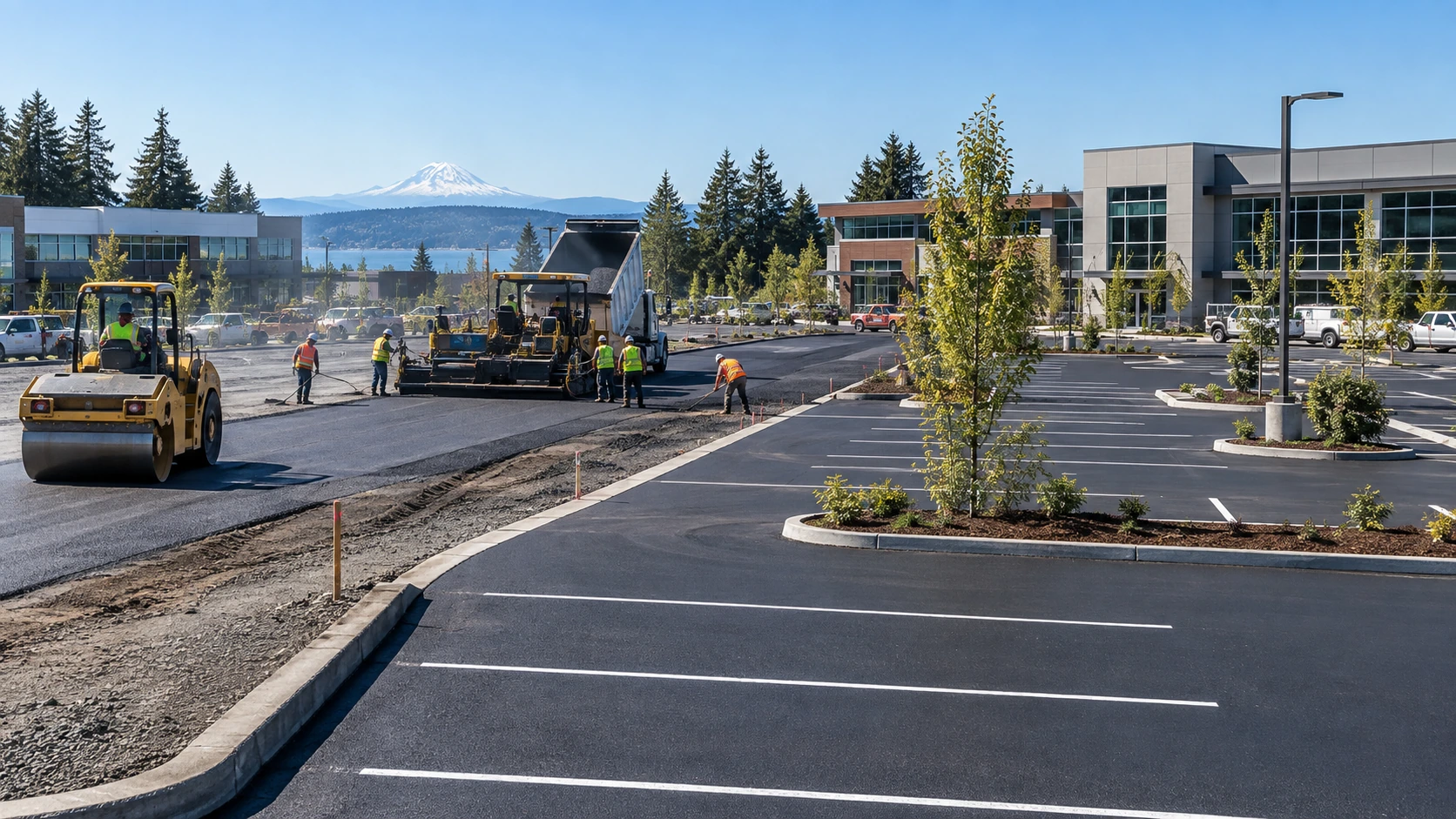
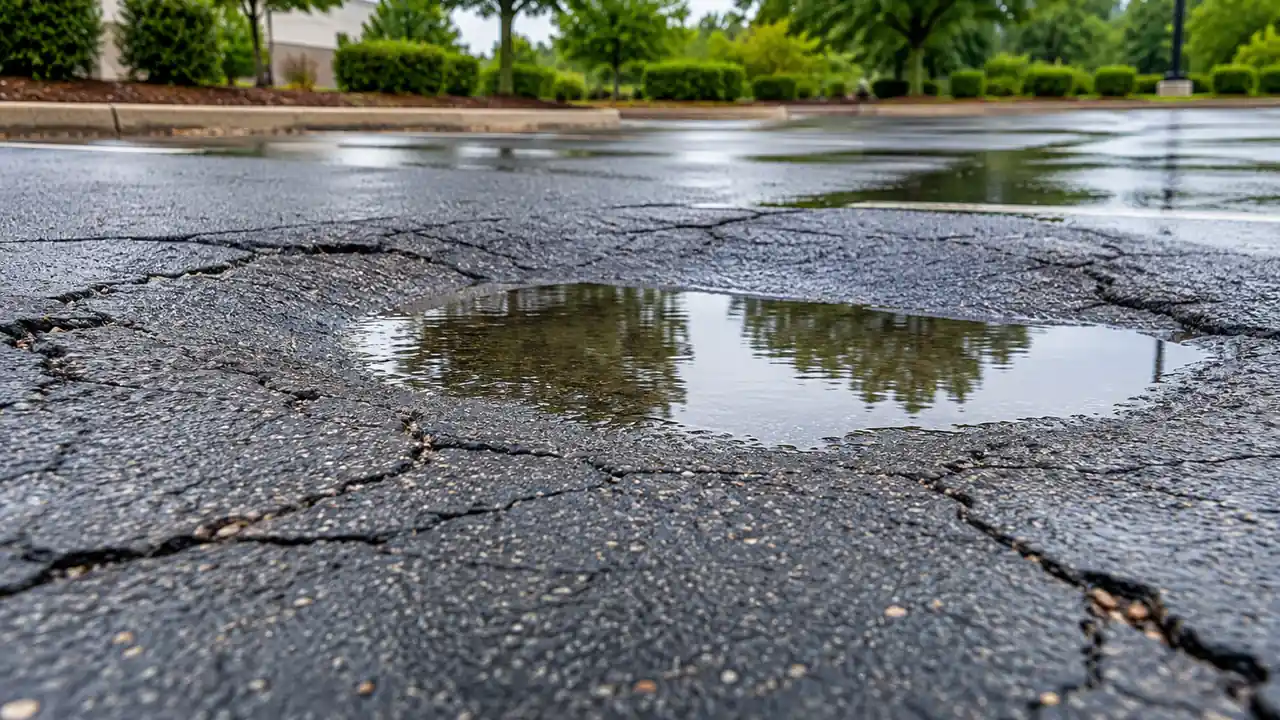
One section of a parking lot sits lower than the surrounding asphalt. Rainwater collects there, vehicles roll through a noticeable dip, or cracks have started spreading around the depressed area. The immediate question is whether the asphalt needs another layer or whether something underneath it has moved.
Common sunken asphalt pavement causes include poorly compacted base materials, settlement of the supporting soil, water damage, repeated heavy traffic, and deformation within the asphalt itself. However, a visible depression does not automatically mean the ground beneath the pavement is sinking.
A shallow low spot caused by uneven surface construction is different from a depression caused by failing soil or material lost around an underground pipe. Both may look similar from above, but they require different repairs.
Knowing what to examine before approving repair work can prevent a property owner from paying to cover a problem that remains unresolved underground.
What Does a Sunken Asphalt Area Actually Mean?
A pavement depression is a localized area where the asphalt surface is lower than the pavement around it. Some depressions develop gradually. Others become noticeable after paving, utility work, heavy traffic, or changes in site drainage.
The important distinction is whether the surface has deformed or the layers supporting it have lost elevation or stability.
Surface deformation
Surface deformation happens when the asphalt layer changes shape under loading or because of mixture, placement, or compaction problems.
For example, a vehicle repeatedly parking in the same position may leave depressions around its tires. The asphalt may be deforming without equivalent movement in the underlying soil.
Base or subgrade settlement
An asphalt pavement normally rests on a prepared foundation. Beneath the asphalt is typically an aggregate base, and below that is the subgrade, the prepared soil supporting the pavement structure.
If the aggregate base consolidates or the soil settles unevenly, the asphalt above it can drop. A depression may develop even when the asphalt material itself was originally placed correctly.
Loss of underground support
In some cases, water carries fine material away, a poorly compacted utility trench settles, or an underground drainage problem causes the supporting material to lose stability.
These conditions deserve particular attention because a surface repair may conceal a larger problem.
The Washington Asphalt Pavement Association identifies inadequate compaction, subgrade settlement, and frost related ground movement as possible causes of localized pavement depressions. Its guidance emphasizes investigating the underlying cause before selecting a repair.
Washington Asphalt Pavement Association+1
Reading the Shape of the Depression Can Narrow Down the Cause
Before discussing repairs, look at the shape of the damaged area. The location, width, surrounding cracks, and relationship to vehicle traffic can reveal useful clues.
The shape alone cannot confirm what is happening underground, but it helps determine what should be investigated first.
| Visible condition | Possible explanation | What to investigate |
|---|---|---|
| Smooth, shallow bowl with no cracking | Uneven paving grade, settlement, or deformation | Surface elevation, construction history, changes over time |
| Long grooves following wheel tracks | Asphalt rutting or deformation in supporting layers | Traffic loads, asphalt condition, base stability |
| Broad dip with interconnected cracks | Loss of support or structural pavement fatigue | Base, subgrade, moisture, and pavement thickness |
| Depression following a straight utility cut | Settlement of trench backfill | Backfill condition, compaction, underground utilities |
| Low asphalt surrounding a catch basin | Local settlement, drainage failure, or unstable backfill | Drain structure, surrounding base, outlet condition |
| Depression that continues expanding | Ongoing settlement or loss of underlying support | Soil movement, erosion, leaks, and subsurface voids |
A narrow groove is not necessarily ground settlement
A depression following tire tracks is commonly classified as rutting.
Rutting can happen within the asphalt mixture, in the aggregate base, or in the subgrade. Inadequate compaction, an unsuitable asphalt mixture, and repeated vehicle loads are possible contributing factors.
The Federal Highway Administration explains that relatively narrow ruts can indicate deformation closer to the surface, while broader wheel path depressions can suggest movement deeper in the pavement structure. These are clues rather than definitive tests.
Federal Highway Administration+1
For a more specific explanation, see asphalt rutting causes and how wheel path depressions develop.
A depression with connected cracks deserves closer attention
Imagine a parking lot where a shallow dip gradually develops a network of small, connected cracks.
Those cracks may indicate that traffic loads are repeatedly bending the pavement over an area with inadequate support.
This pattern can resemble alligator skin. Although the cracking suggests pavement fatigue, a professional still needs to establish whether weakness originates in the asphalt thickness, base, subgrade, or a combination of conditions.
The article on alligator cracking in asphalt explains the relationship between connected cracks and structural pavement distress.
A low spot without cracking can still be a problem
A smooth asphalt depression may remain intact because the pavement has moved without breaking apart.
For example, poorly compacted soil beneath an old utility trench may consolidate gradually, allowing the asphalt above it to settle while remaining relatively uncracked.
Consequently, the absence of visible cracking does not prove that the foundation is sound.
The most useful question is whether the depression is stable or continuing to change.
The Main Reasons One Section of Asphalt Sinks
Localized pavement settlement can occur for several reasons. Understanding the likely mechanisms is important because correcting one cause will not necessarily correct another.
1. Inadequate compaction beneath the pavement
Before asphalt installation, the soil and aggregate base must be prepared to support the anticipated traffic.
Compaction reduces excessive air spaces and helps create stable support.
If an area was not adequately compacted, additional consolidation may occur after construction as vehicles repeatedly load the pavement.
Settlement can become more noticeable where backfill was placed in a trench, around underground structures, or in areas where equipment had limited room to compact the material properly.
Not every depression in newly installed asphalt proves a compaction failure. A contractor should inspect the construction conditions and affected layers before assigning responsibility.
2. Weak or moisture sensitive soil
The subgrade contributes directly to pavement performance.
Some soils become weaker when saturated. If the supporting ground loses strength, vehicle loads can cause further deformation.
A parking lot may have generally stable soil but contain a localized area of softer material. That area may settle even when the surrounding pavement remains relatively level.
Where poor soil conditions are identified, corrective work may require excavation, replacement of unsuitable material, stabilization, or changes to the pavement design.
3. Water movement and erosion beneath the surface
Water can enter the pavement structure through cracks, joints, edges, or other openings.
It may also reach the foundation from surrounding ground or damaged underground infrastructure.
Under certain conditions, flowing water can transport fine particles away from supporting layers. Repeated traffic loads may accelerate deterioration where those materials have become wet or unstable.
Importantly, standing water on top of a depression does not automatically mean underground erosion caused it. The depression may have developed first and then started collecting runoff.
4. Traffic loads that exceed the pavement’s capacity
A parking area designed for passenger vehicles may experience additional stress when larger delivery vehicles regularly use it.
Loading areas, dumpster collection points, and tight turning locations can concentrate loads.
For example, a loaded truck parked repeatedly in one location can expose weaknesses that ordinary passenger car traffic might not reveal.
A repair should consider the vehicles actually using the pavement, not merely the vehicles the area was originally intended to serve.
5. Poor grading or uneven construction elevations
Sometimes a low spot is not the result of settlement at all.
The asphalt may have been placed with an incorrect finished elevation, leaving a shallow basin that collects water.
If the condition has existed since installation and has not changed, an original grading problem becomes a possibility.
The surrounding pavement elevations, drainage design, and construction records can help distinguish poor initial grading from later movement.
Where the surrounding site contributes runoff problems, land grading services may be relevant to the corrective work.
6. Seasonal ground movement
Where freezing temperatures reach susceptible soils, frost heave can temporarily lift pavement. Uneven thawing and subsequent settlement may leave depressions.
Seasonal moisture changes can also affect soil stability.
These mechanisms do not mean every low spot appearing after winter was caused by frost. Site conditions and pavement construction still need to be considered.
The Ohio Department of Transportation identifies weak subgrade, inadequate compaction, drainage problems, erosion, soil movement, and traffic loading among potential pavement settlement causes.
Pavement Repair Guide
Why Drainage Problems and Sunken Pavement Often Occur Together
Water is one of the most important conditions to investigate when a pavement depression develops.
However, it is necessary to separate three different situations.
Water collects because the asphalt has sunk
Consider a parking lot where the pavement originally sloped toward a catch basin.
If a section settles, that section may become the lowest point. Rainwater then collects in the depression instead of continuing toward the drain.
The water is a consequence of the changed elevation.
The repair must restore a suitable surface profile and investigate why the pavement settled.
Poor drainage contributes to the settlement
In another situation, water repeatedly enters the pavement structure through a cracked joint or poorly drained edge.
If the foundation becomes saturated and loses strength, repeated traffic may cause deformation.
The appropriate work could involve both foundation repair and pavement drainage solutions.
Repairing the asphalt without addressing the moisture problem could leave the underlying cause unresolved.
A drainage structure or underground line is failing
An underground drainage issue can create a more localized problem.
Potential conditions include a damaged pipe, an unstable structure, or soil movement around previously excavated and backfilled infrastructure.
For this reason, an expanding depression near an underground utility or stormwater structure should not be treated as a routine cosmetic defect.
A qualified contractor may need to inspect the drainage system before excavation or repaving.
The Federal Highway Administration identifies moisture related weakening, contamination of base materials, and poor drainage as important contributors to pavement distress.
Federal Highway Administration
Special Warning Signs Around Catch Basins and Utility Trenches
Not all pavement depressions deserve the same investigation.
A low spot in the middle of an open parking area is different from one appearing directly above a utility trench or beside a catch basin.
Asphalt sinking around a catch basin
A catch basin collects surface runoff and directs it into a drainage system.
The structure and the surrounding pavement do not necessarily settle at the same rate.
If the material around the basin becomes unstable, the asphalt may drop while the drainage structure remains at its original elevation.
Look for a gap around the basin frame, cracked asphalt surrounding the opening, or water collecting in a place where it cannot reach the inlet.
A repair evaluation may need to consider catch basin installation and repair, rather than simply placing additional asphalt around the frame.
A straight depression following an old trench
A sunken strip that follows a straight line through otherwise level pavement may correspond to a previous utility excavation.
Utility trench repairs involve replacing material removed to install or maintain underground services.
If the backfill consolidates after construction, the asphalt covering it may settle.
This is one of the practical situations discussed in a Reddit discussion about a sunken parking lot trench. Commenters identified trench backfill compaction as a possible explanation for a long, straight depression.
Those comments are individual observations, not confirmation of the cause in any particular property.
Where underground infrastructure is involved, utility coordination services can become relevant before excavation.
A depression near a damaged drain
If a section continues to settle around a drain, the structure and connected piping should be evaluated.
Depending on the findings, the project may involve drain repair before restoring the surrounding pavement.
A practical warning: If a depression has appeared suddenly, expanded noticeably, or shows signs of a possible void, keep vehicles and pedestrians away until a qualified professional has evaluated it. Do not attempt to test its stability by driving over it.
How Property Owners Can Check a Sunken Asphalt Area Before Calling a Contractor
An initial inspection does not require digging into the pavement.
The goal is to collect observations that help a contractor identify what should be investigated.
A practical site inspection checklist
1. Photograph the complete area. Capture the depression and surrounding pavement from multiple angles. Include nearby drains, curbs, buildings, and utility covers where relevant.
2. Record the location. Identify whether the depression occurs in a parking space, wheel path, loading zone, pavement joint, or previous repair.
3. Look for cracking. Note whether the asphalt is smooth, has isolated cracks, or contains connected cracking patterns.
4. Examine the surrounding elevations. If the area is safe and closed to traffic as needed, a straightedge and ruler can help document the depth of a shallow depression. Record the measurement method so future observations are comparable.
5. Observe drainage after rainfall. From a safe location, identify where water collects, where it comes from, and whether the existing drainage system receives it.
6. Check for previous work. Look for rectangular patches, saw cut lines, trench repairs, or nearby underground structures. Review available maintenance records and utility plans.
7. Ask how the area is used. Identify whether passenger vehicles, delivery trucks, dumpsters, or heavy equipment regularly load the affected section.
8. Monitor whether the shape changes. Compare photographs and measurements taken from the same positions. A stable shallow depression may require a different response from an area that continues to move.
Do not enter a traffic lane to measure a depression without appropriate access controls. Never probe an apparent underground void, lift a drain cover, or excavate around utilities as part of a basic property inspection.
For commercial properties, keeping these observations in a parking lot maintenance record can help identify recurring damage.
The most valuable information is not simply how deep the depression appears today. It is how its location, surrounding damage, and condition have changed.
Repair Decision Flowchart: Surface Problem or Deeper Settlement?
Repair selection should follow the likely source of the deformation, not just the depth of the visible low spot.
The following flowchart can help property owners understand the basic decision process. It is a screening tool, not a substitute for an inspection.
Visible asphalt depression
Start with the location, cracking, drainage, and history
Is it rapidly worsening, unstable, or associated with a suspected void?
YES
Restrict access
Arrange prompt professional evaluation of underground support
NO
Review damage pattern
Check wheel paths, drainage, previous repairs, and pavement elevations
What does the investigation establish about the supporting layers?
SUPPORT IS SOUND
Surface correction
Consider localized leveling, milling, or asphalt replacement based on pavement condition and grades
SUPPORT IS DEFICIENT
Foundation correction
Remove deficient material, correct water or utility problems, rebuild support, then repave
There is also a third possible outcome: the investigation may not establish the cause.
In that case, limited testing, closer monitoring, or engineering assessment may be necessary before choosing a permanent repair.
For a broader discussion of pavement distress patterns, see asphalt pavement failure diagnosis.
Which Asphalt Repair Methods Actually Address the Problem?
There is no single repair that fits every pavement depression.
A surface adjustment may be reasonable for a stable low spot with sound support. A deeper failure requires work below the asphalt.
Surface leveling or localized asphalt repair
If the existing pavement structure is sound and the problem is limited to surface elevation, a contractor may consider removing and replacing asphalt or using an appropriate leveling treatment.
The finished surface must maintain suitable drainage, transitions, and pavement thickness.
Simply filling the lowest area is not always enough. New asphalt can create unwanted changes in water flow or surface elevations.
Milling and asphalt overlay
Milling removes part of the existing asphalt surface. An overlay places new asphalt over a prepared pavement.
These treatments may be suitable when the remaining pavement structure is stable and surface correction is needed.
However, an overlay cannot correct unstable soil or a continuing foundation failure by itself.
Before choosing asphalt overlay services, the contractor should establish whether the existing foundation can support the proposed work.
Full depth pavement repair
When asphalt deterioration extends through the pavement layer, removing and replacing the full asphalt thickness may be necessary.
This is different from automatically replacing the soil underneath.
The repair scope must state whether the aggregate base and subgrade are included.
If unstable supporting material is discovered, it should be addressed before placing the replacement pavement.
For damaged areas requiring reconstruction, asphalt paving repair is the relevant service to investigate.
Excavation and foundation reconstruction
If settlement originates below the asphalt, the corrective work may require removing the damaged pavement and excavating the deficient base or soil.
The repair sequence generally involves identifying the failed material, removing or treating it as appropriate, rebuilding the supporting layers, and placing new pavement.
Depending on the problem, civil site work and excavation services may be part of the project.
The correct excavation depth cannot be determined from a surface photograph alone.
Why crack filling and sealcoating are not settlement repairs
Crack filling can help limit water entering suitable cracks in otherwise serviceable pavement.
It cannot lift a sunken section or restore a failed foundation.
Similarly, sealcoating treats the pavement surface. It does not rebuild missing support beneath the asphalt.
If the existing surface is otherwise stable, crack filling services may be useful as part of routine maintenance. They should not be mistaken for a structural settlement correction.
Ohio DOT’s pavement repair guidance distinguishes localized repair, resurfacing, and more extensive reconstruction based on distress severity, extent, and underlying conditions.
Pavement Repair Guide
What Should a Contractor Investigate Before Recommending a Repair?
A credible repair recommendation should explain why the observed depression has developed.
That does not mean every low spot requires extensive testing. It means the level of investigation should be appropriate to the condition.
Inspecting the existing pavement
A contractor may begin with the surface elevations, crack pattern, previous patches, traffic use, and surrounding drainage.
The inspection should consider whether the depression follows a wheel path, trench, paving joint, or underground structure.
The surrounding pavement is important because an apparently isolated failure may be connected to problems beyond the visible dip.
Checking asphalt and foundation conditions
When visual evidence is insufficient, more detailed evaluation may involve asphalt cores, test openings, or other appropriate investigation methods.
These can help establish pavement thickness and the condition of the layers beneath it.
Where significant settlement or underground movement is suspected, geotechnical or engineering input may be warranted.
Identifying the affected repair area
The visible depression does not always represent the complete area requiring repair.
For example, unstable material may extend beyond the cracked or depressed section.
The proposed repair boundaries should reflect the condition of the pavement and its supporting layers.
A contractor should also explain how the repaired area will connect to the surrounding asphalt.
Checking drainage and access requirements
A completed repair must work with nearby curbs, stormwater structures, walkways, and traffic routes.
For a commercial parking lot, the plan should identify which areas must be closed and how customers, delivery vehicles, and pedestrians will continue using the property.
The appropriate approach depends on the size of the repair and site conditions.
What Causes Asphalt Depressions to Return After Repair?
A repaired area that starts sinking again may indicate that the original cause was never completely addressed.
Recurrence does not automatically prove poor workmanship. New or continuing site conditions may also contribute.
Several situations deserve attention.
The repair covered unstable material
Placing asphalt over a weak base may temporarily restore the surface elevation.
If the material beneath it continues to deform, another depression can develop.
A permanent repair should address deficient support when investigation establishes that it is present.
The drainage problem remains
If water continues entering the same area, the supporting materials may remain vulnerable.
A repaired surface should be assessed in relation to the surrounding drainage system.
For example, the finished surface may be smooth but still slope toward a location where runoff cannot escape.
The pavement continues receiving excessive loads
Repairing a depressed loading area without examining the traffic may leave the original loading conditions unchanged.
A pavement serving delivery trucks, refuse collection vehicles, or heavy equipment may require a structural design appropriate to that use.
The repair plan should account for actual operating conditions.
The repair area was too limited
A small patch may not include all the deficient material or the surrounding pavement that has already lost support.
The appropriate boundary depends on the investigation rather than the smallest visibly damaged area.
A contractor should explain how the repair limits were chosen.
Questions to Ask Before Approving a Sunken Asphalt Repair Quote
Two contractors may recommend different solutions for the same depression.
One may price a surface patch. Another may include excavation, aggregate replacement, drainage work, and full pavement reconstruction.
Those prices cannot be compared fairly without understanding the scope.
Before approving the project, ask the following questions.
| Question | Why it matters |
|---|---|
| What is the likely cause of the depression? | Determines whether surface work is sufficient |
| How was the cause identified? | Distinguishes observed evidence from assumptions |
| Is the base or subgrade being inspected? | Helps establish whether deeper support problems exist |
| Will the estimate include removal of unsuitable material? | Clarifies what happens if the foundation is unstable |
| How will drainage be corrected or maintained? | Helps prevent water from collecting in the repaired area |
| Does the repair include proper material placement and compaction? | Establishes how the supporting layers will be rebuilt |
| What traffic loads is the repaired area intended to handle? | Helps ensure the repair is appropriate for site use |
| How will unexpected underground conditions affect the price? | Reduces uncertainty about additional work |
| When can the area return to service? | Helps coordinate parking, deliveries, and pedestrian access |
| What does the workmanship warranty cover? | Clarifies responsibilities and exclusions |
Repair costs depend on the area involved, pavement depth, access, material conditions, drainage work, utility requirements, and the extent of reconstruction.
A small surface correction and a repair involving excavation are fundamentally different projects.
A site assessment is therefore more useful than applying a generic price to every sunken asphalt area.
Common Questions About Sunken Asphalt Pavement
Can asphalt sink without cracking?
Yes. Asphalt may remain relatively intact while the supporting layers settle, creating a smooth depression. However, a low spot can also result from surface deformation or uneven initial grading.
The absence of cracks does not establish the condition of the underlying soil.
Why does one section of a parking lot sink while the rest stays level?
A localized depression may occur where the base or subgrade differs from the surrounding area.
Possible reasons include a poorly compacted utility trench, weak soil, concentrated traffic, underground water movement, or a localized construction problem.
Determining the cause requires evaluating the affected area and its history.
Can you put new asphalt over a sunken area?
Sometimes a surface correction is appropriate when the underlying pavement structure is sound.
If the low spot is caused by an unstable base, continuing settlement, or an underground void, covering it with new asphalt does not correct the underlying problem.
The condition of the supporting layers should guide the repair.
Does standing water always mean the asphalt is sinking?
No.
Standing water can result from incorrect surface grading, blocked drainage, inadequate slopes, or pavement settlement.
A puddle identifies a drainage concern, but does not establish which condition caused it.
Is a sunken asphalt area a sinkhole?
Not necessarily.
Many pavement depressions result from routine structural deformation, inadequate compaction, or localized settlement.
A sinkhole involves loss of ground support or collapse associated with subsurface conditions. A rapidly developing depression or suspected void needs prompt professional assessment, but a surface dip alone should not be labeled a sinkhole.
How can I tell whether a depression is getting worse?
Take photographs from consistent locations and record the visible dimensions when safe.
Compare the depression over time, including changes in depth, cracking, surrounding pavement elevations, and water accumulation.
A worsening condition should be assessed rather than repeatedly filled without investigation.
Can a settled parking lot be repaired without replacing the entire surface?
Often, localized repair is possible when the affected area is limited and the surrounding pavement remains structurally sound.
More extensive settlement, drainage failures, or widespread foundation instability may justify a larger rehabilitation project.
The decision depends on the condition and extent of the damage.
Schedule a Settlement Evaluation Before Covering a Sunken Area
A sunken asphalt section is a visible symptom, not a complete diagnosis.
The correct repair depends on whether the problem comes from surface deformation, inadequate base support, soil settlement, drainage problems, or underground infrastructure.
If a parking lot, driveway, or access area has developed a depression, start by documenting the condition and arranging an appropriate inspection.
Adams Asphalt & Construction provides asphalt repair, drainage, excavation, grading, and related construction services in Kent and the Greater Puget Sound region.
Share photographs, details of previous repairs, and information about the vehicles using the area so the initial evaluation can focus on the conditions most likely to matter.