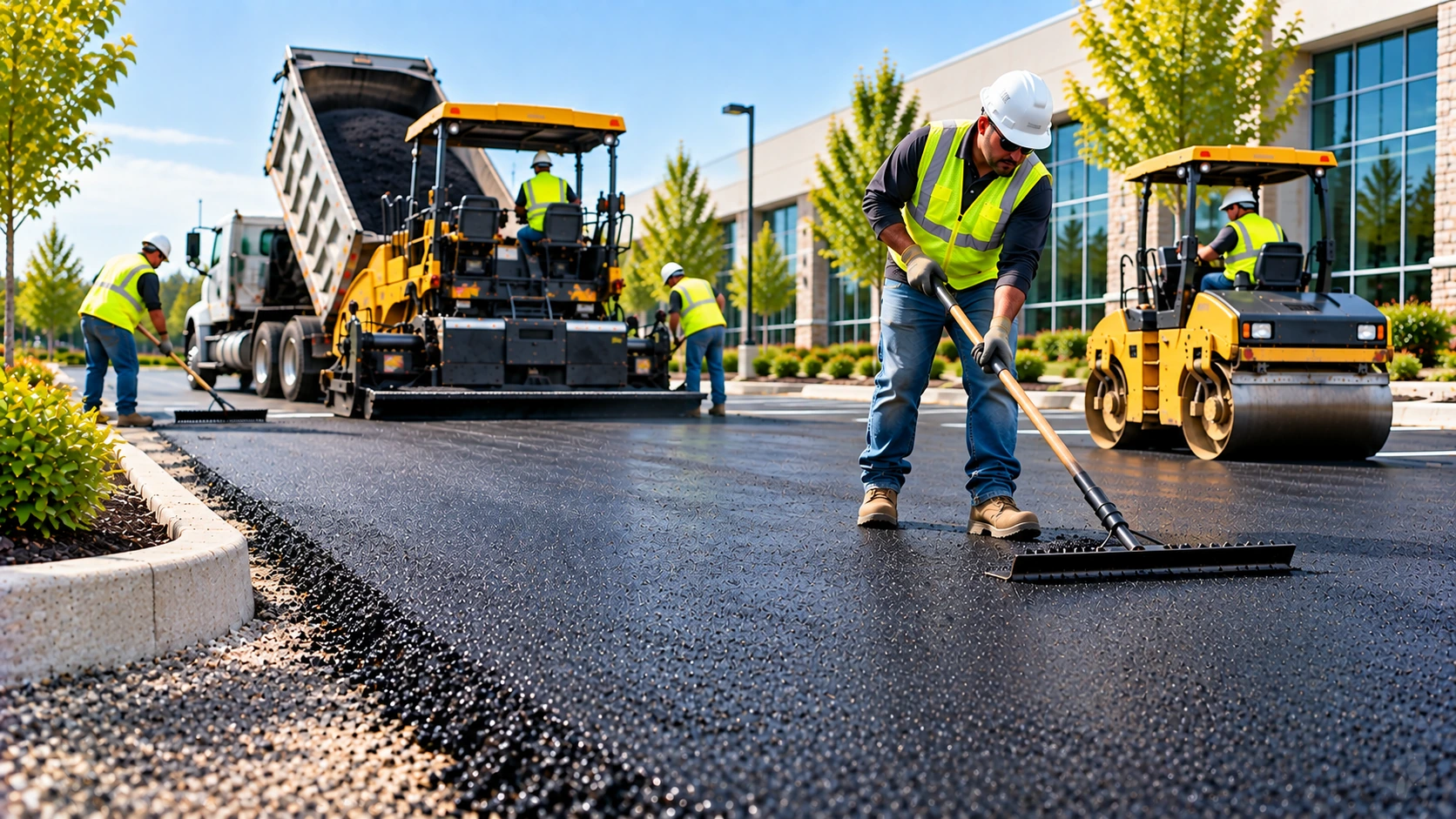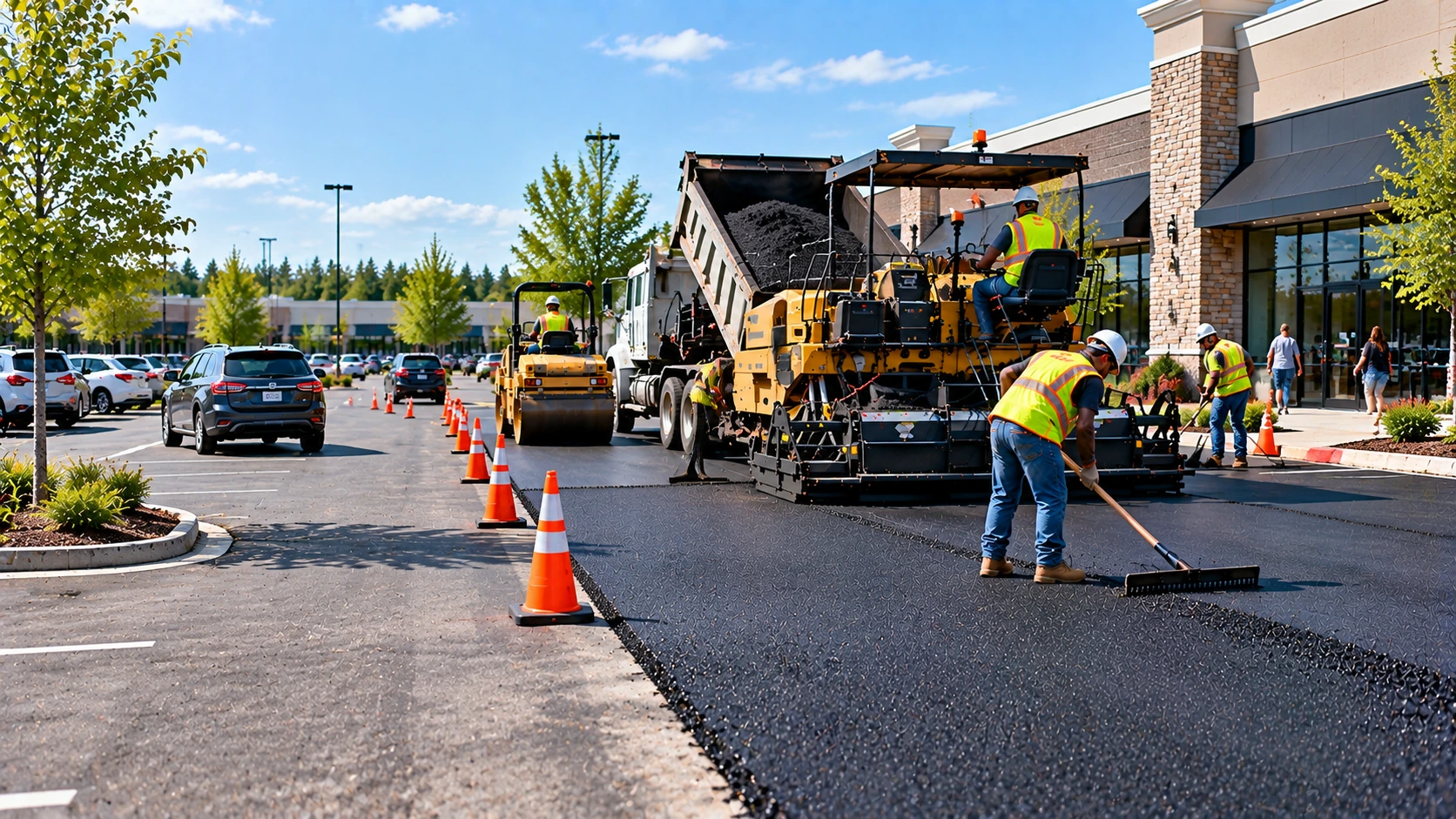
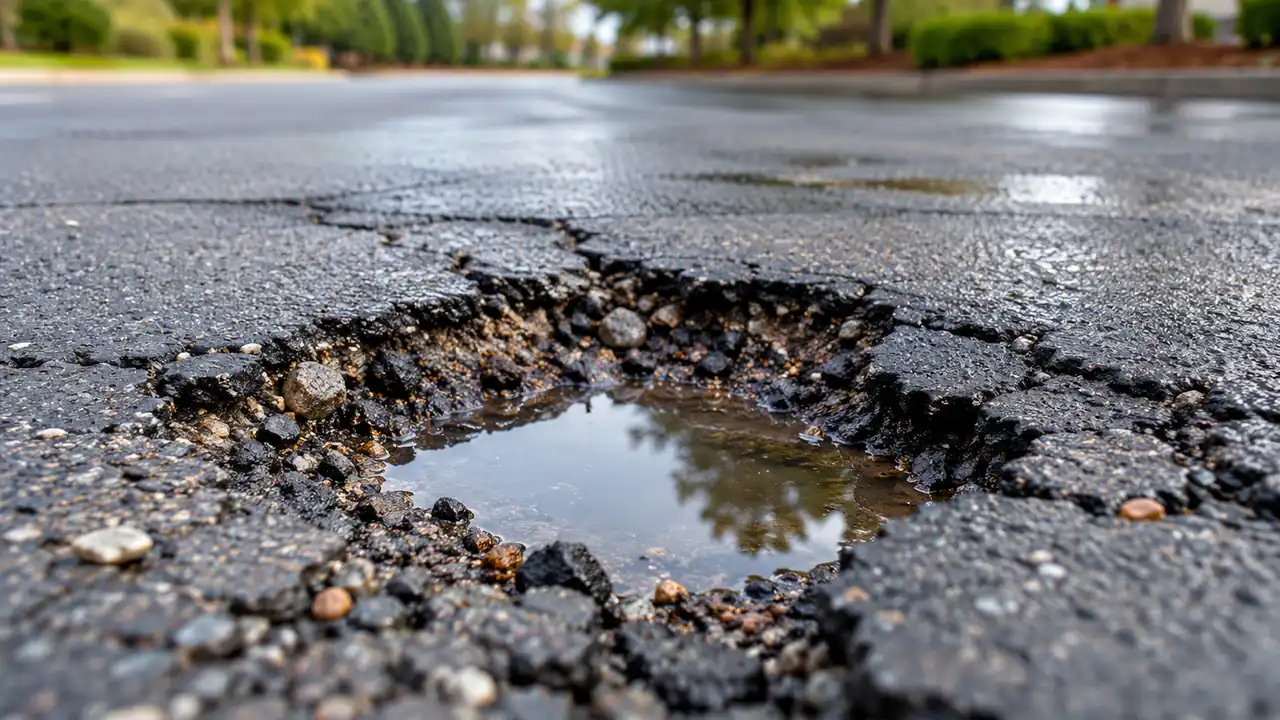
A pothole gets filled, the pavement looks smooth again, and traffic returns to normal. Then, a few weeks or months later, cracks appear around the repair. The patch begins to sink, pieces break loose, and another pothole develops in almost exactly the same location.
When this happens repeatedly, the problem may not be the new asphalt itself.
The most common recurring pothole causes include weakened pavement foundations, trapped moisture, inadequate compaction, failing repair edges, and repairs that do not extend deep enough to remove damaged material. Heavy traffic can make these conditions worse.
A patch may restore the driving surface without correcting the weakness underneath it. Once water and vehicle loads begin acting on that weak area again, the repair can fail.
Understanding why the pothole returned is more useful than simply choosing another patching material. The goal is to identify which part of the pavement is failing and what it will take to repair it properly.
Why Does a Pothole Return to the Same Location After Repair?
An asphalt surface depends on the materials beneath it for support. When a vehicle travels across pavement, its weight transfers through the asphalt into the supporting layers.
A typical asphalt pavement structure includes the asphalt surface, a prepared aggregate base where specified, and the underlying soil, known as the subgrade.
If these layers remain stable, the pavement can distribute traffic loads as intended. When the foundation softens, settles, or loses supporting material, the asphalt above it can bend and crack.
Eventually, pieces of asphalt may break away and form a pothole.
Now imagine a repair crew fills that opening with new asphalt but leaves the weakened material underneath untouched.
The surface looks repaired. However, traffic continues applying pressure to the same unstable foundation.
Over time, the new material can crack, move, or separate from the surrounding pavement.
This explains why a pothole returning after repair is often a sign that the visible damage was only part of the problem.
It does not automatically mean the previous contractor performed poor work. Some repairs are intentionally temporary because of weather, traffic access, or the condition of the surrounding pavement.
However, repeated failure is a reason to investigate beyond the surface.
For a broader explanation of different pavement distress patterns, see our guide to asphalt pavement failure diagnosis.
Six Common Causes of Recurring Pothole Failure
A failed patch can have several contributing causes. In some cases, the repair material is the problem. In others, the surrounding pavement or underlying foundation is responsible.
1. The Base Underneath the Asphalt Is Weak
The aggregate base distributes loads and helps support the asphalt. If this material is poorly compacted, contaminated with unsuitable soil, saturated, or displaced, it may no longer provide adequate support.
As vehicles pass over the area, the pavement can flex downward.
That movement creates stress in the asphalt layer. Repeated loading can eventually produce cracks and broken pavement.
A surface patch does not restore missing or weakened base material.
Imagine a parking lot where the same pothole has been repaired twice. The new patches appear sound immediately after installation but gradually develop depressions.
If the material beneath the repair is settling under vehicle loads, replacing only the asphalt will not stop the movement.
The damaged area may need to be excavated so the supporting materials can be inspected and corrected.
2. Water Continues Entering the Pavement Structure
Water is a major factor in many repeat asphalt failures.
Moisture can enter through cracks, open joints, deteriorated edges, and other pavement openings.
When excessive water reaches moisture sensitive base or subgrade material, it can reduce the supporting strength of the pavement system.
Traffic then places additional stress on the weakened area.
In some conditions, moving water can also carry fine material away from underneath the pavement, creating gaps or localized loss of support.
Rainwater collecting on the surface is another warning sign. A persistent low spot can expose cracks and joints to water for longer periods.
In properties with recurring ponding, proper drainage solutions may need to be considered alongside asphalt repair.
The important distinction is that water visible on the surface does not prove the base is saturated. Likewise, a dry surface does not prove the underlying materials are dry.
The source and movement of moisture need to be evaluated.
3. The Repair Did Not Remove Enough Damaged Pavement
A pothole may appear small while the surrounding asphalt is already cracked or weakened.
If a contractor removes only the loose material inside the visible hole, damaged pavement can remain around its edges.
Those weakened edges may break under traffic, gradually enlarging the opening.
The Washington State Department of Transportation explains in its pavement patching and repair guidance that repair areas should extend beyond the visible distress to sound material.
This does not mean every pothole requires extensive excavation. The appropriate repair boundary depends on what is found during evaluation.
However, patching against deteriorated asphalt can leave a weak connection between the repaired section and the existing pavement.
If the surrounding area has interconnected cracking that resembles an alligator’s skin, the problem may involve more widespread pavement fatigue.
Our article on alligator cracking in asphalt explains why this pattern deserves closer inspection.
4. The Patch Was Not Compacted Properly
Compaction is the process of pressing asphalt material together to achieve the density and stability required for the repair.
Insufficient compaction can leave excessive air voids and allow the patch to deform under traffic.
As the material settles, a depression may form.
Water can collect in that depression, creating another opportunity for moisture to enter the pavement.
Proper compaction depends on several conditions, including material type, placement temperature, layer thickness, equipment, and access to the repair area.
Simply placing asphalt into a hole and leveling the surface does not establish that the material has been compacted adequately.
The supporting aggregate or soil may also require compaction when a repair involves excavation below the asphalt.
That distinction matters because a well compacted asphalt patch can still settle if the base beneath it was not adequately prepared.
5. The Repair Edges Are Not Properly Bonded
The point where new asphalt meets existing pavement is an important part of any patch.
If the repair is placed against loose, dirty, crumbling, or poorly prepared edges, the connection may not remain intact.
Traffic and weather can eventually create separation along the joint.
Once the joint opens, water has another path into the pavement structure.
A tack coat, which is a thin application of asphalt bonding material, may be used as part of the specified patching process to improve adhesion.
However, tack coat is not a substitute for removing unstable material or preparing the supporting base.
Cracks around an otherwise sound repair may sometimes be addressed through suitable asphalt crack filling methods.
If the patch or surrounding pavement is moving, filling the joint alone will not correct that movement.
6. The Repaired Area Cannot Support Repeated Traffic Loads
Not every paved area receives the same type of traffic.
A residential driveway may primarily support passenger vehicles, while a commercial loading area could experience repeated truckloads, braking, and turning.
These demands place different stresses on the pavement.
A patch that performs adequately in a lightly traveled parking space may not be appropriate for an area subjected to frequent heavy vehicle movement.
Repeated loading can also contribute to rutting, which appears as depressions along wheel paths.
When wheel path depressions accompany recurring potholes, it is worth reviewing the causes of asphalt rutting before deciding on the repair.
For commercial sites, the placement and design of pavement in loading zones used by delivery trucks may influence the type and extent of reconstruction needed.
A repair should account for the traffic it will actually carry.
What Does the Failed Patch Tell You About the Problem?
The way a repair deteriorates can help narrow down possible causes.
A patch that sinks is different from one that breaks apart at the surface. Cracks forming along the perimeter also suggest a different investigation from cracks developing across the middle.
The following observations can help property owners describe the problem more accurately.
| Visible condition | Possible explanation | What should be checked |
|---|---|---|
| Patch sinks below the surrounding pavement | Base settlement, inadequate compaction, or loss of support | Supporting layers and signs of movement |
| Cracks develop around the patch edges | Weak surrounding asphalt, joint movement, or inadequate bonding | Repair boundaries, edge condition, and adjacent pavement |
| Asphalt breaks into small loose pieces | Surface deterioration, material issues, or compaction problems | Asphalt condition and whether damage extends deeper |
| Pothole returns after repeated rainfall | Moisture infiltration or drainage related weakness | Surface grades, joints, drainage structures, and underlying moisture |
| Damage develops along a truck wheel path | Repeated loading or insufficient pavement support | Traffic demands and pavement structure |
| Repair fails near a utility trench or drain | Settlement, water infiltration, or loss of supporting material | Previous excavation, drainage components, and nearby utilities |
These observations are clues, not confirmed diagnoses.
For example, a sinking patch could result from inadequate compaction beneath a utility trench. It could also indicate material loss caused by leaking infrastructure.
The surface appearance alone may not distinguish between those conditions.
Watch for Damage Beyond the Original Pothole
A recurring pothole should not be evaluated in isolation.
Check the adjacent pavement for cracking, settlement, loose aggregate, rutting, and unusual surface movement.
If small stones are separating from the pavement, asphalt raveling may also be occurring.
If nearby pavement is visibly sinking, the damaged area could extend farther than the original patch.
A contractor may need to investigate the surrounding pavement before establishing the final repair limits.
How Does Water Keep Damaging a Repaired Pothole?
A common question is why a patch can appear intact while the pavement around it continues deteriorating.
The answer is that moisture does not have to enter through the center of the repair.
Water can travel along the joint between old and new asphalt. It can also enter through nearby cracks or reach the pavement foundation from another source.
Surface Drainage Problems
Consider a parking lot where a pothole repeatedly develops near a catch basin.
After rainfall, water collects in the same low area.
The recurring failure could involve the pavement grade, the condition of the drainage structure, or surrounding base materials.
Patching the hole may temporarily restore the surface, but it does not necessarily change how runoff moves across the lot.
A drainage evaluation can help determine whether water is being collected and carried away as intended.
Our guide to drainage solutions for flood prone sites explains several conditions that should be reviewed when surface runoff is not being controlled.
Water Below the Pavement
Not every moisture problem begins at the surface.
Water can also reach supporting materials through underground drainage defects, leaking pipes, or surrounding soil conditions.
A pothole that repeatedly returns near a utility trench deserves attention to possible settlement and infrastructure issues.
However, the presence of a nearby utility does not establish that a pipe is leaking.
Further investigation may be necessary.
Why Sealing the Patch Is Not Always Enough
Sealing a sound joint can help limit water infiltration.
But consider a repair where the aggregate base has already become unstable.
Closing the surface opening does not rebuild that foundation.
Likewise, if water is reaching the area through another route, sealing only the visible patch joint may not stop the moisture problem.
Effective repairs address the relevant source of water as well as the damaged pavement.
Is Cold Patch Asphalt the Reason the Pothole Keeps Coming Back?
Cold patch asphalt is commonly used for emergency and temporary repairs because it can be placed without the equipment and temperature controls associated with conventional hot mix asphalt installation.
It can be useful when a pothole needs attention quickly, particularly when weather or site conditions make other repair methods impractical.
However, using cold patch does not automatically mean the repair was performed incorrectly or that it will fail immediately.
Repair performance depends on the material, preparation, compaction, pavement condition, traffic, and intended service life.
Cold Patch Versus Hot Mix Asphalt
Cold patch material is often selected for quick maintenance work. Depending on the product and conditions, some applications can remain serviceable for an extended period.
Hot mix asphalt is commonly used for planned repairs where proper preparation, placement, and compaction can be completed.
The Federal Highway Administration’s manual of practice for pothole repairs discusses different patching methods, including rapid repairs and more extensively prepared repairs.
The important distinction is not simply cold material versus hot material.
It is whether the repair method is appropriate for the pavement’s condition and intended purpose.
Can Hot Mix Asphalt Still Fail?
Yes.
Hot mix asphalt placed over an unstable foundation may crack or settle even when the surface initially looks good.
The same is true if damaged pavement remains around the patch or if the repair joints are inadequately prepared.
Choosing a different asphalt material will not necessarily correct a structural problem.
Before paying to replace a failed cold patch with hot mix, ask whether the supporting base has been evaluated.
Why Do Patch Edges Matter So Much?
A pothole patch is not an isolated piece of asphalt. It must function alongside the pavement around it.
The edge of the repair is where the new material meets the existing structure.
If the surrounding asphalt is sound, properly prepared, and appropriately bonded, the joint has a better chance of remaining intact.
If the adjacent asphalt is crumbling or moving, the joint may fail even when the newly placed material is properly compacted.
Cutting Back to Sound Pavement
For planned repairs, a contractor may saw cut the damaged area to create defined edges.
This allows loose and deteriorated material to be removed and gives the new asphalt a more stable boundary.
A straight cut by itself does not guarantee the repair will succeed. The surrounding pavement must still be structurally suitable.
Preparing and Compacting the Joint
Loose debris and unsuitable material can interfere with bonding and compaction.
Depending on the specified repair process, crews may clean the opening, apply tack material, place asphalt, compact it with suitable equipment, and finish the surface to match the surrounding grade.
The repaired joint should also be considered during subsequent maintenance.
An opening at the perimeter can become a path for moisture, even when the center of the patch remains intact.
How Should a Contractor Diagnose a Recurring Pothole?
A recurring pothole usually deserves a more detailed evaluation than an isolated hole that has appeared for the first time.
The investigation should establish whether the failure is limited to the asphalt or involves deeper supporting materials.
A practical assessment may involve the following sequence.
- Review the repair history. Identify when previous repairs were completed, what materials were used, and how quickly deterioration returned.
- Examine the surrounding pavement. Look for interconnected cracking, settlement, rutting, edge deterioration, and other signs that the visible pothole may be part of a larger damaged area.
- Check surface drainage. Review pavement slopes, catch basins, nearby joints, and places where water collects after rainfall.
- Consider traffic demands. Identify whether heavy trucks, turning vehicles, or repeated wheel loads concentrate stress in the damaged area.
- Investigate the underlying structure when justified. A contractor may recommend opening the affected section, examining the aggregate base, or performing appropriate tests to establish its condition.
- Define the repair scope. Determine which materials must be removed, whether the base requires correction, how drainage will be handled, and what construction methods are appropriate.
Not every project requires pavement coring, extensive testing, or engineering analysis.
An isolated defect in otherwise sound asphalt may be straightforward to repair.
Repeated settlement, widespread cracking, significant drainage problems, or uncertainty about underground conditions can justify additional investigation.
The approach should match the seriousness of the problem.
Excavation near utilities should be performed only after appropriate utility location and safety requirements have been addressed.
How Deep Should a Recurring Pothole Be Repaired?
There is no single repair depth that is correct for every pothole.
The appropriate depth depends on the condition of the asphalt, aggregate base, subgrade, and surrounding pavement.
Three general repair approaches are commonly considered.
| Repair approach | When it may be appropriate | What it does not fix |
|---|---|---|
| Localized surface repair | Damage is limited to the upper asphalt layer and supporting material remains sound | Deeper structural weakness |
| Full depth asphalt patch | The full asphalt thickness is damaged but the foundation is stable | Uncorrected base or subgrade failure |
| Base repair with asphalt replacement | Supporting aggregate or soil is unstable and requires correction | Drainage or loading problems left outside the repair scope |
If the base is soft or unsuitable, excavation may need to continue below the existing asphalt.
Damaged supporting material can then be corrected or replaced as appropriate before the asphalt is reconstructed.
The required aggregate type, layer thickness, asphalt thickness, and compaction approach depend on the site and any applicable project specifications.
For more information about the construction layers involved, see our guide to the asphalt paving process, costs, and maintenance.
Does a Deeper Patch Always Last Longer?
No.
A deeper repair may be necessary when the damage extends through the pavement structure. But removing more material than needed does not automatically produce a better result.
If drainage remains poor or the repaired pavement is still unsuitable for the traffic it carries, further deterioration may occur.
The objective is to repair the damaged structure to the depth and extent required by actual site conditions.
When Is Another Patch Reasonable, and When Is Replacement Better?
Repeated repairs do not always mean an entire driveway or parking lot needs to be replaced.
The correct decision depends on how much pavement is damaged and whether the remaining structure is sound.
When Localized Repair Still Makes Sense
A localized repair may be reasonable if the failure is confined to a limited area.
For example, consider an otherwise sound parking lot with one pothole caused by deterioration around a previous utility cut.
If the problem is restricted to that location and the surrounding pavement remains stable, excavating and reconstructing the affected section may be sufficient.
Professional asphalt paving and repair services can address localized failures without automatically replacing large areas of usable pavement.
When a Larger Section May Need Reconstruction
Suppose a parking lot has several recurring potholes in the same drive aisle.
The surrounding asphalt also shows interconnected cracking, wheel path depressions, and settlement.
In that situation, patching each hole separately may leave much of the deteriorated pavement untouched.
A larger repair area may be needed to remove damaged materials and establish stable boundaries.
The same consideration applies when multiple failed patches are connected by cracked or unstable pavement.
Why an Overlay May Not Solve the Problem
An asphalt overlay adds new material over an existing pavement surface.
It can be appropriate when the underlying structure is reasonably stable and the pavement requires resurfacing.
However, covering an unstable area does not necessarily remove the reason it failed.
Cracks, settlement, or movement in the underlying pavement can eventually affect the new surface.
Before selecting resurfacing, structural problems should be identified and corrected where necessary.
For property managers responsible for larger paved areas, our article on HOA parking lot capital planning explains how to distinguish immediate repair needs from larger improvement projects.
What Should You Ask Before Paying for Another Pothole Repair?
When a pothole has already been patched several times, the next estimate should explain more than the cost of placing new asphalt.
A useful proposal should establish what the contractor intends to remove, what conditions may require additional work, and how the repaired area will be supported.
Before approving the work, consider these questions.
| Question | Why it matters |
|---|---|
| What caused the previous patch to fail? | Separates observed damage from suspected underlying problems |
| Will the surrounding pavement and base be inspected? | Helps determine whether the repair extends far enough |
| How will unstable or wet material be handled? | Establishes whether deeper problems are included in the work |
| What repair depth and materials are proposed? | Makes the scope easier to understand and compare |
| How will the asphalt and supporting layers be compacted? | Addresses an important part of repair performance |
| Will drainage or traffic loading require additional work? | Identifies conditions that may cause another failure |
| What happens if unexpected damage is found during excavation? | Clarifies how changes to the scope and price will be handled |
A contractor may not be able to confirm every condition before opening the pavement.
For that reason, a clear proposal should distinguish confirmed work from possible additional repairs.
It should also describe how those decisions will be made if hidden damage is discovered.
Comparing estimates only by the size of the patch or the total price can be misleading when contractors are proposing different repair depths and methods.
How Can You Reduce the Chance of Potholes Returning?
Preventing another pothole begins with controlling the conditions that contribute to pavement deterioration.
Even a properly completed repair needs reasonable maintenance and suitable operating conditions.
Keep Drainage Systems Functioning
Inspect catch basins and accessible drainage structures for debris, sediment, and visible damage.
Watch for standing water that repeatedly collects near repaired pavement.
If a previously dry area begins holding water, investigate what changed.
Blocked drainage structures, damaged components, or altered surface grades may require attention.
Address Cracks Before They Allow Additional Water Entry
Cracks should be evaluated based on their width, pattern, location, and likely cause.
Suitable crack sealing or filling can help limit moisture infiltration when the pavement remains structurally sound.
However, widespread fatigue cracking should not be treated as a simple sealing problem.
If the pavement is moving or breaking apart, a more substantial repair may be necessary.
Pay Attention to Repeated Heavy Vehicle Movement
Some parts of a property experience considerably more stress than others.
Delivery entrances, garbage collection areas, loading spaces, and turning locations can develop localized damage from repeated traffic.
If a repair repeatedly fails in one of these locations, the pavement structure should be evaluated against actual vehicle use.
Inspect Previous Repairs After Rainfall
Rain can reveal depressions, runoff problems, and joint openings that are less obvious during dry weather.
Look for changes in pavement elevation, widening cracks, or water collecting near a repaired area.
Take photographs and record when changes first appear.
For commercial properties, a regular inspection routine can help distinguish new damage from existing issues.
Our guide to proper parking lot maintenance explains other pavement conditions worth monitoring.
Questions Property Owners Ask About Recurring Potholes
Why does the pothole keep returning even after professional repair?
The previous repair may not have corrected a deeper condition, such as unstable supporting material, moisture infiltration, or deterioration beyond the visible hole. Repair materials, compaction, and joint preparation may also affect performance. The actual cause requires inspection.
Can water underneath asphalt cause a pothole to return?
Yes. Excess moisture can weaken supporting materials, while flowing water may contribute to the loss of fine material in some conditions. Repeated traffic over areas with reduced support can cause cracking and pavement failure.
Can sealing the edges of a patch stop it from failing?
Sealing suitable joints may help reduce water entry, but it will not correct a weak foundation or ongoing movement. If the repair is sinking, cracking extensively, or losing support, additional investigation is appropriate.
Should a recurring pothole always be repaired with hot mix asphalt?
No. Material selection depends on the pavement condition, weather, traffic, and purpose of the repair. Hot mix asphalt is often used for planned permanent repairs, but it must be installed over stable supporting materials with appropriate preparation and compaction.
Does a pothole returning mean the entire parking lot needs replacement?
Not necessarily. Localized reconstruction may solve the problem when the surrounding pavement remains sound. Larger repairs or replacement become more relevant when distress is widespread or the supporting pavement structure has deteriorated over a substantial area.
Why does a patch sink without developing obvious cracks?
Settlement can occur when the material beneath the asphalt compresses or loses support. A depression alone does not establish the cause. The condition of the base, subgrade, and any previous excavation should be investigated.
Diagnose the Cause Before Paying for Another Patch
A pothole that returns repeatedly is a reason to question what is happening beneath and around the repaired area.
Sometimes the solution is straightforward. A damaged joint, poorly prepared patch, or limited area of deteriorated asphalt may need a properly completed localized repair.
Other situations involve saturated supporting materials, settlement, inadequate pavement strength, or drainage conditions that require more extensive work.
The objective should be to correct the actual failure, not simply restore the appearance of the surface for another short period.
Adams Asphalt & Construction provides asphalt repair, paving, and drainage services for commercial and residential properties throughout Kent and the Greater Puget Sound region.
If the same pothole keeps returning on your driveway, parking lot, private road, or access area, contact our team to discuss the pavement condition and arrange an evaluation of the recurring damage.