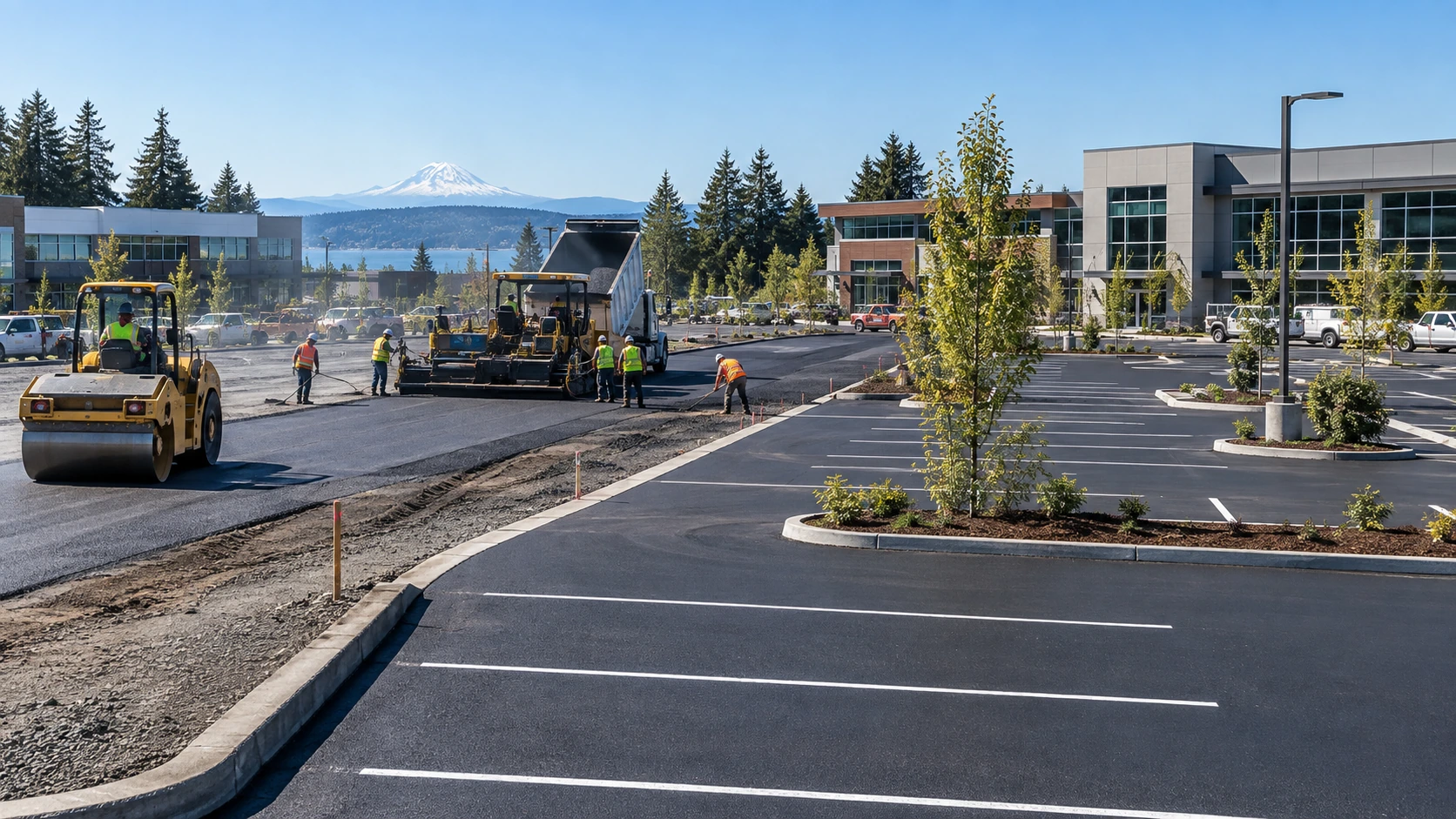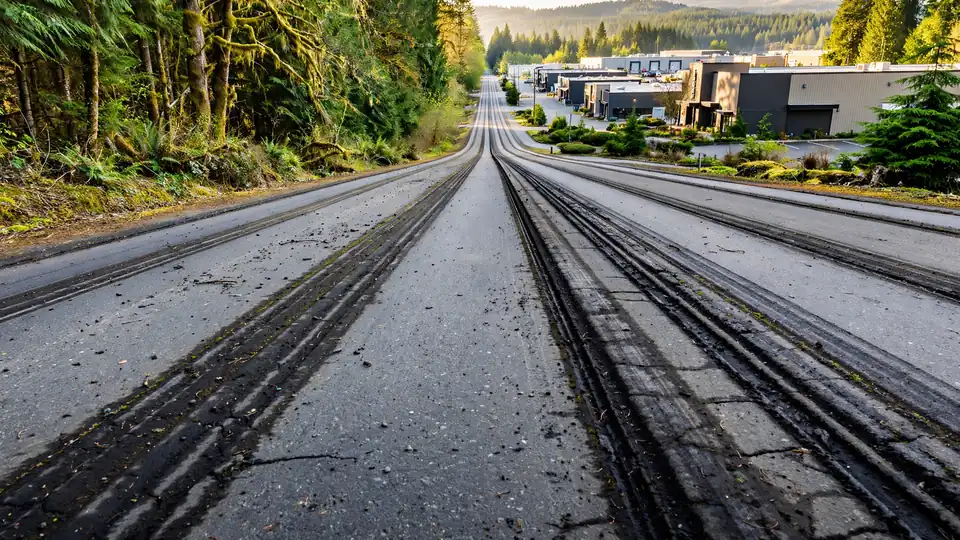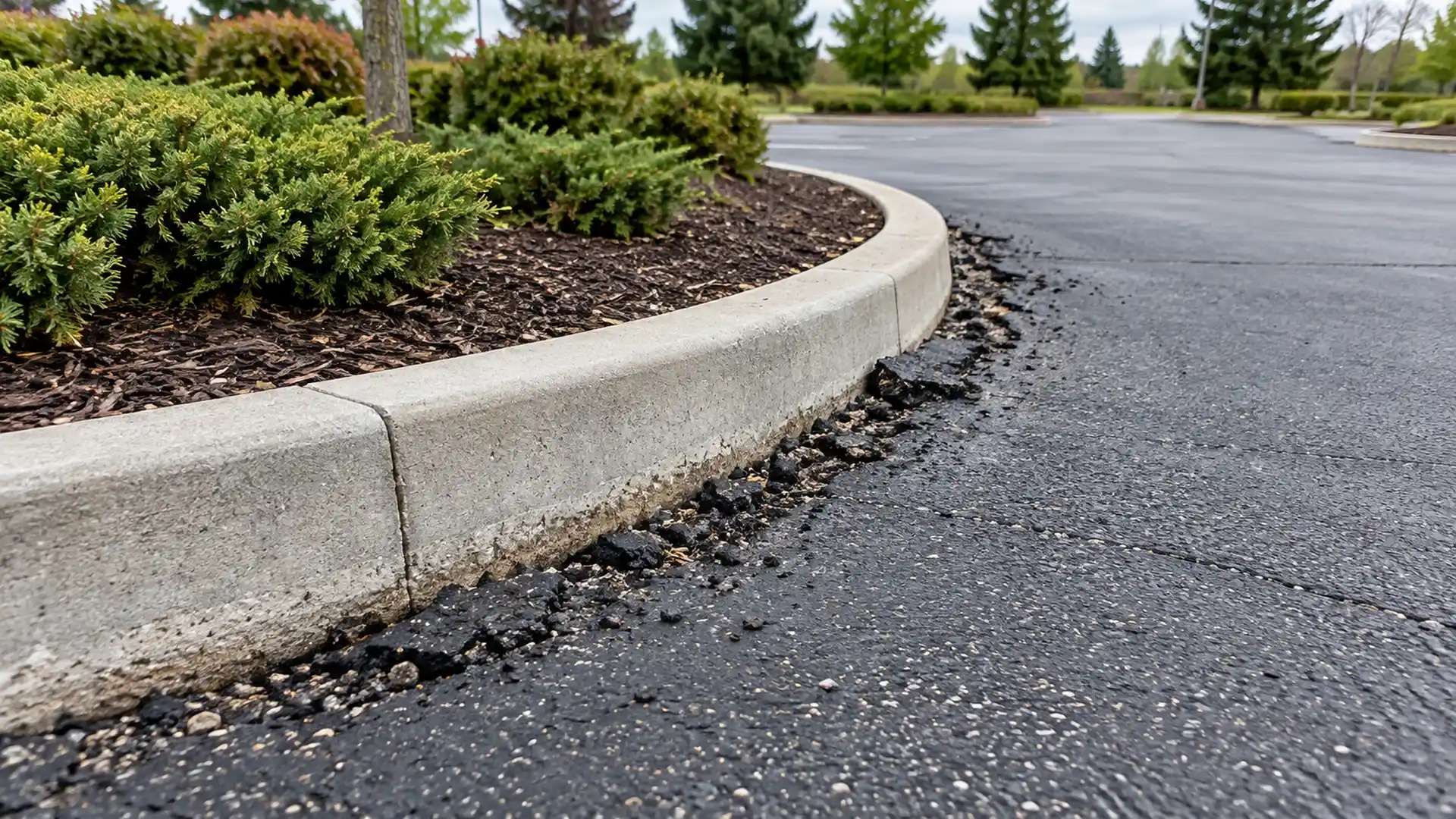
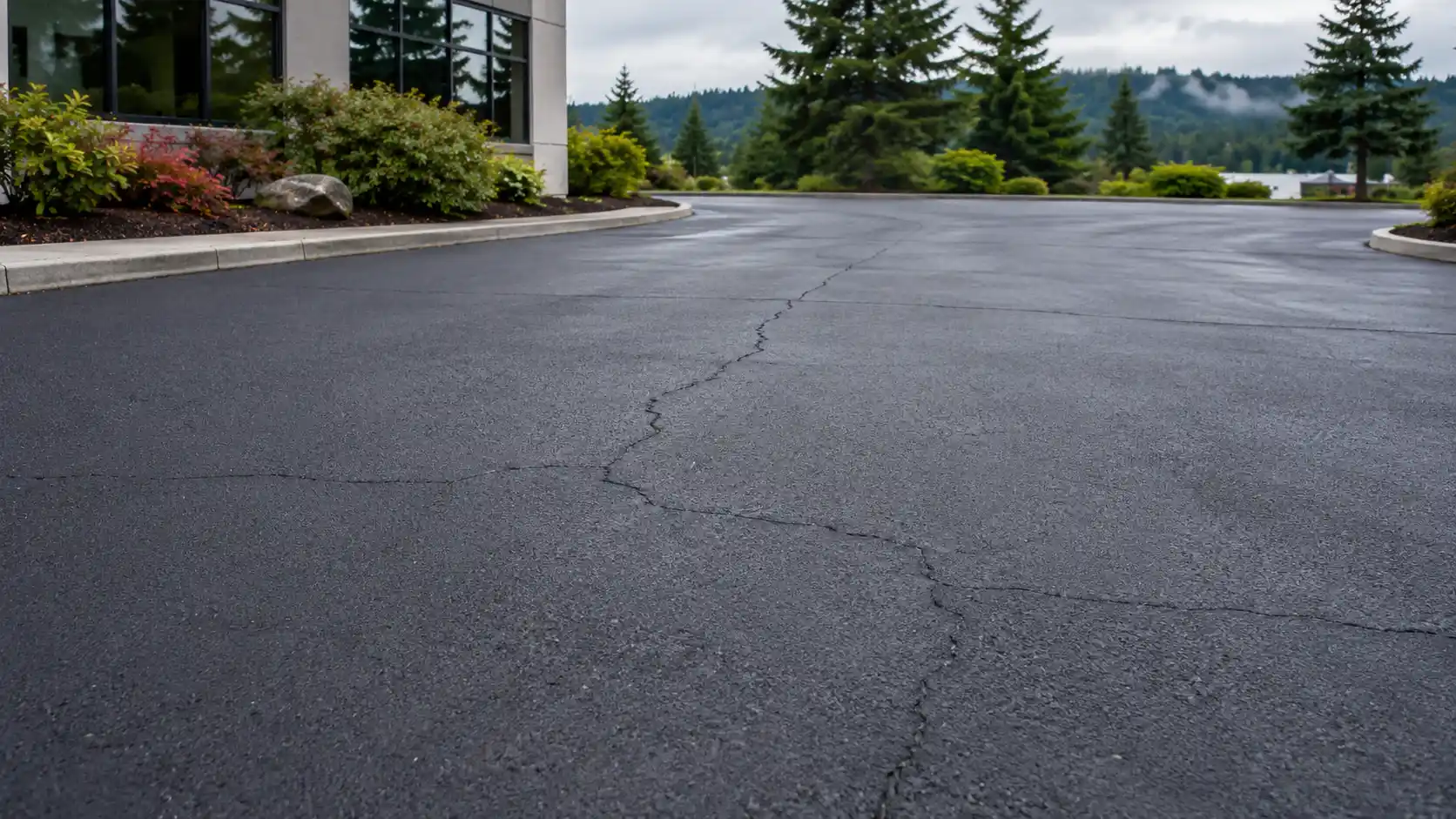
Reflective cracking after asphalt overlay occurs when cracks, joints, or movement in the pavement underneath eventually create cracks in the new asphalt surface above. The overlay may initially look completely smooth, but it does not automatically eliminate the conditions that caused movement in the older pavement.
That distinction matters when a recently resurfaced driveway, parking lot, private road, or commercial pavement begins showing familiar crack lines.
The new asphalt itself may not be the original source of the problem. Movement can continue below the new surface because of temperature changes, traffic loads, weakened pavement layers, old joints, drainage problems, or unrepaired structural damage.
The Federal Highway Administration describes reflective cracks as cracks that develop in an asphalt overlay above cracks or joints in the pavement underneath. Movement below the overlay can create tensile and shear stresses that gradually propagate upward through the new asphalt.
Understanding what the crack pattern is telling you is more useful than simply sealing every visible line.
Why Can Old Cracks Reappear Through New Asphalt?
An asphalt overlay adds a new pavement layer, but the old pavement remains part of the structure.
Imagine an existing asphalt surface with a transverse crack running across it. A new layer is placed over the entire area. The crack is no longer visible, but the two sides of the older crack may still move slightly as temperatures change or vehicles pass across the pavement.
The new asphalt bridges that movement.
Repeated movement places stress in roughly the same area of the overlay. Eventually, a crack can form in the new layer above the old one.
This process explains why resurfaced pavement can develop a crack that appears to follow almost exactly the same path as one that existed before the overlay.
Reflection cracking can occur over older asphalt pavement as well as over concrete pavement. It is particularly recognizable over concrete because joints beneath the asphalt can create regularly spaced transverse cracks at the surface. FHWA notes that reflective cracking commonly develops above underlying pavement joints and cracks as horizontal movement, vertical movement, and repeated loading stress the overlay.
This is also why choosing an asphalt overlay should involve evaluating what is underneath the existing surface, not only how the pavement looks from above.
A New Overlay Does Not Make the Old Pavement Inactive
Resurfacing and rebuilding are different operations.
An overlay uses the existing pavement structure as part of the rehabilitated system. That can make it an appropriate option when the pavement below remains reasonably stable and the distress can be addressed before resurfacing.
If the pavement underneath is still moving, settling, pumping, breaking apart, or losing support, covering it does not necessarily stop those processes.
A useful way to think about an overlay is as a new wearing and structural layer placed over an existing foundation. Its performance still depends partly on the condition of that foundation.
WSDOT guidance for asphalt pavement rehabilitation emphasizes identifying existing distress before the overlay and determining where pavement repairs are required. Its guidance distinguishes ordinary surface cracking from areas where cracks extend through the asphalt and pavement support has deteriorated.
For pavement with isolated damage, targeted asphalt pavement repair before resurfacing may address the failed sections while preserving pavement that is still structurally useful.
The challenge is deciding which cracks are primarily surface problems and which ones are evidence of movement deeper in the pavement.
The Crack Pattern Often Reveals What Is Happening Below
Not every crack appearing after resurfacing is reflective cracking.
The location, spacing, direction, surrounding surface condition, and relationship to known old cracks all matter.
Cracks returning in the same location
When a new crack closely follows a crack that was visible before resurfacing, reflection should be considered. The old crack may still be opening, closing, or shifting below the overlay.
Regular transverse cracks
Repeated cracks running across the pavement at fairly consistent spacing may correspond to joints in underlying concrete pavement.
FHWA specifically identifies reflection cracking at joints as cracking in an asphalt overlay that occurs above joints in concrete pavement. Knowing the underlying slab pattern can help distinguish these cracks from ordinary transverse cracking.
Cracks around previous repairs
A crack following the edge of an old patch can indicate movement where pavement materials, thicknesses, or support conditions change.
That does not automatically mean the repair was performed incorrectly. The edge simply creates a location where different pavement sections may respond differently to loading and temperature.
Cracking with settlement or deformation
A crack becomes more concerning when it appears alongside depressions, rutting, pumping, uneven elevation, or repeated pavement breakup.
Those additional symptoms can indicate a support problem rather than an isolated surface crack.
In that situation, another layer of asphalt may not address the actual cause.
Temperature and Traffic Create Different Types of Movement
Reflective cracking is not caused by a single mechanism.
Two major forces can act on the overlay.
Horizontal movement from temperature changes
Pavement materials expand and contract as temperatures change.
An existing crack or concrete joint may open and close during these cycles. The asphalt above must repeatedly stretch across the moving area.
Over enough cycles, that repeated strain can contribute to a crack propagating through the overlay.
Vertical movement under traffic
Vehicle loads can also cause one side of an underlying crack or joint to move differently from the other.
If support beneath the pavement is uneven, the vertical movement can become more significant. The overlay then experiences shear stress as traffic crosses the area.
FHWA identifies temperature related movement, slab curling, traffic loading, poor load transfer, and inadequate support as important mechanisms behind reflection cracking.
This distinction helps explain why simply filling a visible crack before resurfacing may not solve every situation. Filling the opening can limit water entry and prepare the surface, but it does not necessarily stop structural movement underneath.
Water Can Turn a Crack Problem Into a Support Problem
Water deserves attention whenever cracks return after resurfacing.
Once an open crack develops, water can enter the pavement structure. If drainage is poor, moisture may weaken unbound base material or the supporting soil beneath the asphalt.
FHWA identifies water intrusion, inadequate drainage, and erosion of supporting materials as factors that can contribute to reflective cracking and pavement movement.
This creates a damaging cycle.
A crack provides a path for water. Moisture reduces support in vulnerable areas. Greater movement places additional stress on the crack. The opening becomes wider or begins deteriorating around its edges.
That is why an overlay evaluation should not stop at the crack itself.
Nearby standing water, clogged drainage structures, low areas, runoff patterns, soft pavement edges, or evidence of pumping may point toward a broader water management issue.
When water is contributing to pavement deterioration, correcting the source through appropriate pavement drainage solutions can be more important than repeatedly repairing the same surface symptom.
Does Reflective Cracking Mean the Overlay Failed?
Not necessarily.
A visible reflective crack tells you that movement from the underlying pavement has reached the overlay. It does not, by itself, explain the severity of the underlying condition.
An isolated narrow crack over an otherwise stable pavement is very different from repeated cracking accompanied by settlement, potholes, pumping, or widespread surface breakup.
The timing also deserves attention.
If cracks return unusually early, the pavement should be evaluated to determine why movement was able to transfer through the overlay so quickly. Possible factors include untreated active cracks, failed pavement sections beneath the overlay, poor support, drainage problems, movement at concrete joints, or rehabilitation that was not suited to the existing pavement condition.
The correct question is therefore not simply, “Why did the new asphalt crack?”
A more useful question is, “What is moving underneath this crack, and how serious is that movement?”
That question leads to a much better repair decision.
What Should Be Evaluated Before Placing an Asphalt Overlay?
The condition survey before resurfacing often has a major influence on what happens afterward.
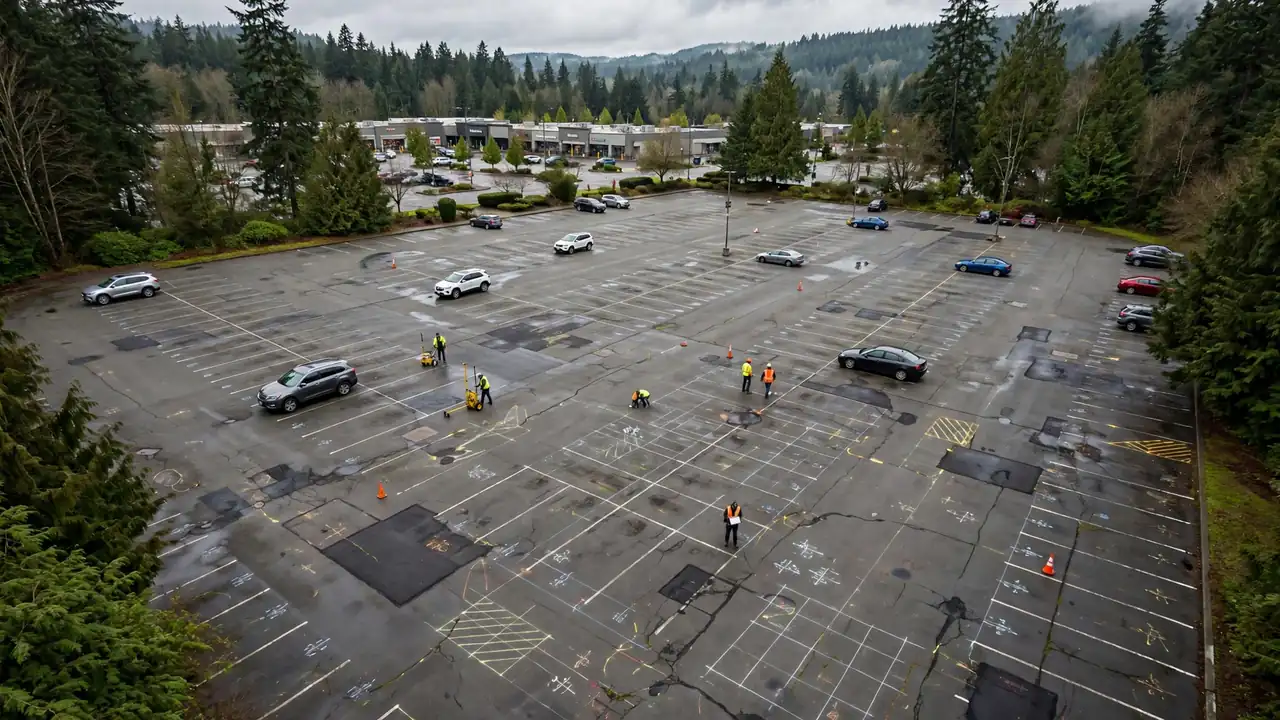
The pavement should first be inspected for the type and pattern of existing distress. Cracks, potholes, patches, rutting, settlement, drainage problems, failed edges, and visibly unstable sections can indicate very different underlying conditions.
Existing cracks also need context.
A relatively stable surface crack presents a different problem from interconnected cracking over a soft or moving pavement section.
WSDOT’s rehabilitation guidance requires existing distress to be identified so areas needing pavement repair can be addressed. Its guidance also calls for crack treatment before an asphalt overlay in applicable conditions and recommends looking for supporting evidence such as pavement depression, pumping, or coring when deeper pavement failure is suspected.
Surface preparation may therefore involve several different operations depending on what the evaluation finds.
Some cracks may need appropriate crack filling or sealing. Failed pavement may require removal and replacement. Uneven areas may need corrective work. Poor drainage may need attention before new asphalt is placed.
Where the underlying pavement remains suitable for rehabilitation, a properly planned overlay can still be an effective way to restore the surface and extend useful pavement service.
For readers planning a larger project, the broader asphalt paving process, cost, and maintenance guide provides additional context about how pavement condition affects project planning.
Can Reflective Cracking Be Prevented Completely?
There is no single treatment that guarantees old cracks will never appear through a new asphalt layer.
That is one of the most important expectations to establish before resurfacing.
Different projects may use crack treatment, localized pavement repair, milling, reinforcing or stress relieving layers, increased overlay thickness, repairs to concrete joints, removal of failed pavement, or more extensive rehabilitation methods.
The appropriate method depends on what is underneath the asphalt and how much movement is expected.
FHWA guidance notes that treatments performed before an overlay can reduce or delay reflective cracking, but preventive measures do not necessarily eliminate it in every pavement system.
Some pavement conditions require a more aggressive strategy.
For example, WSDOT completed an Interstate 5 rehabilitation project in 2026 using a crack, seat, and overlay process. Existing concrete pavement was intentionally broken into smaller sections and seated to create a more stable base before asphalt was placed above it. That type of treatment is designed for a very different pavement condition and scale than routine private property resurfacing, but it illustrates the underlying principle: sometimes controlling movement below the overlay requires changing the old pavement structure itself.
For ordinary commercial and residential projects, the decision may be much simpler. The important part is matching the repair strategy to the pavement condition instead of assuming every cracked surface needs the same treatment.
When Is Crack Treatment Enough, and When Is Deeper Repair Needed?
The answer depends on what the crack represents.
| Pavement condition | What it may indicate | Typical evaluation direction |
|---|---|---|
| Isolated crack with stable surrounding pavement | Localized crack movement | Determine whether crack treatment and monitoring are appropriate |
| Old crack returning through an overlay | Movement continuing beneath the new layer | Evaluate the original crack and surrounding pavement |
| Crack with depression or movement | Possible loss of support | Inspect base and underlying pavement condition |
| Repeated cracks matching concrete joint spacing | Joint related reflection | Evaluate joint movement and overlay condition |
| Cracking with standing water or pumping | Drainage or support issue | Investigate water movement and pavement support |
| Widespread cracking with structural deformation | Broader pavement failure | Compare rehabilitation with removal and replacement |
The goal is to avoid treating a structural symptom as if it were only a surface maintenance issue.
For example, sealing a stable reflective crack can help limit water entry and slow deterioration around the opening. That can be useful maintenance.
If the crack is repeatedly moving because the pavement below has lost support, sealing the top may still be worthwhile for moisture control, but it will not rebuild the supporting layers.
A localized failed section may require asphalt repair before the surrounding pavement can be successfully resurfaced.
More extensive pavement failure may justify comparing rehabilitation with new asphalt paving rather than continuing to place new material over an unstable structure.
Why Milling Alone Does Not Always Remove the Cause
Milling is often used before resurfacing to remove deteriorated asphalt, correct elevations, improve surface profile, or create room for the new pavement layer.
But removing part of the old surface does not automatically remove a crack that extends deeper into the pavement.
Suppose a crack passes through most or all of the existing asphalt thickness. Milling the upper portion may temporarily remove what is visible, while the lower portion of the crack remains.
Once the new overlay is placed, movement can continue from that deeper crack.
The same principle applies when cracking originates from a concrete joint or from unstable support beneath the asphalt. Surface removal alone does not change what is happening farther down.
That is why milling should be viewed as one part of pavement rehabilitation rather than a universal solution for reflection cracking.
Where pavement failure reaches deeper layers, localized reconstruction, base correction, or related civil site preparation may need to be considered before the finished surface is replaced.
What Should You Do When Cracks Appear in a Recent Overlay?
Start by documenting the pattern instead of immediately covering the crack.
Look at where the cracks appear, whether they follow previous cracks or patches, and whether they are transverse, longitudinal, isolated, or repeated.
Next, inspect the pavement around them.
A crack surrounded by sound, level pavement tells a different story from one beside a depression, pothole, soft edge, or area that holds water.
The drainage conditions should also be checked. Water entering through an open crack can increase deterioration, particularly where the base or subgrade is already vulnerable.
If the cracking continues to change, widens, develops edge deterioration, or appears with movement in the pavement, a professional evaluation can help determine whether the issue is limited to the surface or extends deeper.
The objective should be diagnosis before treatment.
Repeatedly filling the same crack without understanding why it keeps returning may control water temporarily, but it can also delay recognition of a deeper problem.
Planning the Next Repair Around the Cause
Reflective cracking is a reminder that pavement behaves as a system.
The surface, existing asphalt, concrete joints where present, base material, soil support, drainage, traffic, and temperature all interact.
A new overlay can restore a worn pavement when the underlying structure is suitable for rehabilitation. It cannot guarantee that active movement underneath will disappear.
That is why the condition of the existing pavement should guide the repair method.
Stable cracks may call for maintenance. Localized failures may need deeper pavement repair. Drainage problems should be corrected when water is contributing to deterioration. Widespread structural movement may require a larger rehabilitation or replacement strategy.
If cracks are showing through an existing overlay, Adams Asphalt & Construction can evaluate the pavement condition and existing overlay to help determine whether crack treatment, localized repair, resurfacing, or more extensive pavement work should be considered.
The important part is finding the cause before adding another layer.