Industrial Roadway Paving is not simply a heavier version of a standard parking lot. Industrial routes may carry repeated truckloads, tighter turning movements, loading activity, and round-the-clock facility traffic, so the pavement system has to be evaluated around how the site actually operates.
For property owners and facility managers in Kent and the Greater Puget Sound region, the key difference is use. Commercial asphalt paving often serves passenger vehicles, light deliveries, and customer access, while industrial routes may need to accommodate freight traffic, concentrated axle loads, and higher operational demands.
What Is the Difference Between Industrial and Commercial Paving?
The core distinction comes down to loading, site conditions, and operational demands. Standard commercial areas often handle cars and light service vehicles. Industrial areas can face repeated semi-truck traffic, trailers, forklifts, turning loads, braking forces, and staging activity.
That changes how a project team evaluates the subgrade, aggregate base, drainage, compaction, pavement section, and construction sequence.
Factor Standard Commercial Areas Industrial Roadways Typical traffic Cars, vans, light deliveries Trucks, trailers, fleet and industrial vehicles Load pattern Moderate and distributed Repeated, concentrated, or slow-moving Turning stress Usually lower Often higher near docks and intersections Base evaluation Based on traffic and site conditions Greater attention may be needed where heavy loads repeat Drainage Important Critical where water can weaken support under heavy traffic Operations Customer and employee access Truck routing, staging, loading, and facility access
In short, industrial paving vs commercial paving is less about the property label and more about what the pavement must carry every day.
Why Heavy Loads Change the Pavement Conversation
Heavy-duty asphalt paving is typically considered where repeated truck or equipment traffic creates greater stress than ordinary passenger-vehicle use. The concern is not just total vehicle weight. Axle loads, braking, acceleration, slow turns, and frequent stops can concentrate stress in specific areas.
An asphalt pavement for heavy loads should therefore be evaluated as a system, not only as a surface layer. When teams evaluate heavy truck traffic asphalt pavement, they are really assessing how repeated axle loads interact with the base, subgrade, drainage, and surface over time. The condition of the soil, base, drainage, compaction, and traffic pattern all influence long-term performance.
For readers comparing industrial asphalt paving vs commercial paving, this is the most important distinction: industrial routes are often planned around repeated loading and site operations, while many commercial areas are dominated by lighter vehicles.
Facilities may also need different pavement approaches within the same property. Employee parking may perform under one traffic pattern while truck lanes, dock approaches, and loading areas face another.
Where Industrial Paving Requirements Often Become More Demanding
Industrial properties usually contain several pavement zones rather than one uniform surface.
Truck Routes and Access Roads
Truck route paving has to account for the paths heavy vehicles use most often, including entrances, internal circulation lanes, and turning points. Industrial access road paving may also need to coordinate with site grading, drainage, and adjoining paved areas.
Warehouses and Distribution Centers
Warehouse paving can include employee parking, loading approaches, truck circulation, and service areas with very different traffic conditions. Distribution center paving often adds frequent tractor-trailer movement, staging, and high-use delivery routes.
Manufacturing Facilities and Truck Yards
Manufacturing facility paving may support delivery vehicles, fleet traffic, industrial operations, and service access. Industrial truck yard paving can involve frequent turning, queueing, trailer movement, and concentrated wheel paths.
Loading Areas
Loading dock paving deserves close attention because trucks may brake, reverse, turn, and remain stationary in a small area. Those repeated movements can create different stresses than free-flowing traffic.
Why the Base and Subgrade Matter So Much
The asphalt surface is only the visible part of the pavement system. Below it, the subgrade and aggregate base help transfer traffic loads into the ground.
Industrial pavement base preparation may include evaluating weak areas, existing failures, drainage, grading, and support conditions before new asphalt is placed. Likewise, subgrade preparation for asphalt paving should reflect the actual soil and project requirements rather than a one-size-fits-all specification.
If the support layers are unstable or moisture-damaged, adding asphalt at the surface may not address the root cause. That is why site conditions matter before deciding whether a roadway needs repair, overlay, or more extensive reconstruction.
AAC can also coordinate relevant civil site work, excavation, grading, or drainage improvements when those services are part of the approved project scope.
Does Industrial Pavement Always Need to Be Thicker?
No. Industrial pavement thickness should never be reduced to a universal number.
The appropriate pavement section depends on factors such as expected traffic, axle loads, subgrade strength, aggregate base, drainage, materials, compaction, and project specifications. A thicker surface alone cannot compensate for poor support or persistent water problems.
The better question is not “How thick should industrial asphalt always be?” but “What pavement structure fits this site, traffic pattern, and operating environment?”
That distinction supports better decisions and avoids treating every industrial property the same way.
Compaction and Construction Quality Affect Performance
Asphalt compaction for heavy traffic matters because proper density helps the pavement perform as intended under repeated use. Compaction, however, is only one part of quality construction. Surface preparation, base condition, lift placement, drainage, and project-specific requirements all contribute to performance.
Industrial asphalt paving should therefore be viewed as a coordinated construction process rather than simply the placement of a thicker asphalt layer.
Industrial road construction may also involve grading, excavation, drainage coordination, access planning, and sequencing before paving begins.
Drainage Is a Structural Performance Issue, Not Just a Water Problem
Industrial pavement drainage affects more than surface convenience. Water that reaches or remains in supporting layers can weaken pavement support and contribute to deterioration, especially where heavy vehicles repeatedly use the same wheel paths.
Industrial roadway drainage should account for how water moves across and away from the pavement, including surface grades, low areas, pavement edges, catch basins, and existing drainage infrastructure.
This is especially relevant in the Puget Sound region, where regular rainfall makes runoff management an important part of site planning. Standing water, poor grades, or saturated support conditions can make an already stressed industrial route more vulnerable.
Why Rutting and Other Failures Need Diagnosis Before Repair
Industrial pavement rutting appears as depressed wheel paths, but the visible rut does not always reveal the full cause. Repeated loading, material deformation, insufficient support, poor drainage, or underlying base problems can all contribute.
The same principle applies to cracking, settlement, and localized surface deformation. A repair that treats only the visible symptom may not solve an underlying structural or drainage issue.
This is why property managers should distinguish between maintenance, localized repair, overlay, and reconstruction rather than assuming every pavement defect has the same solution.
How Project Phasing Protects Facility Operations
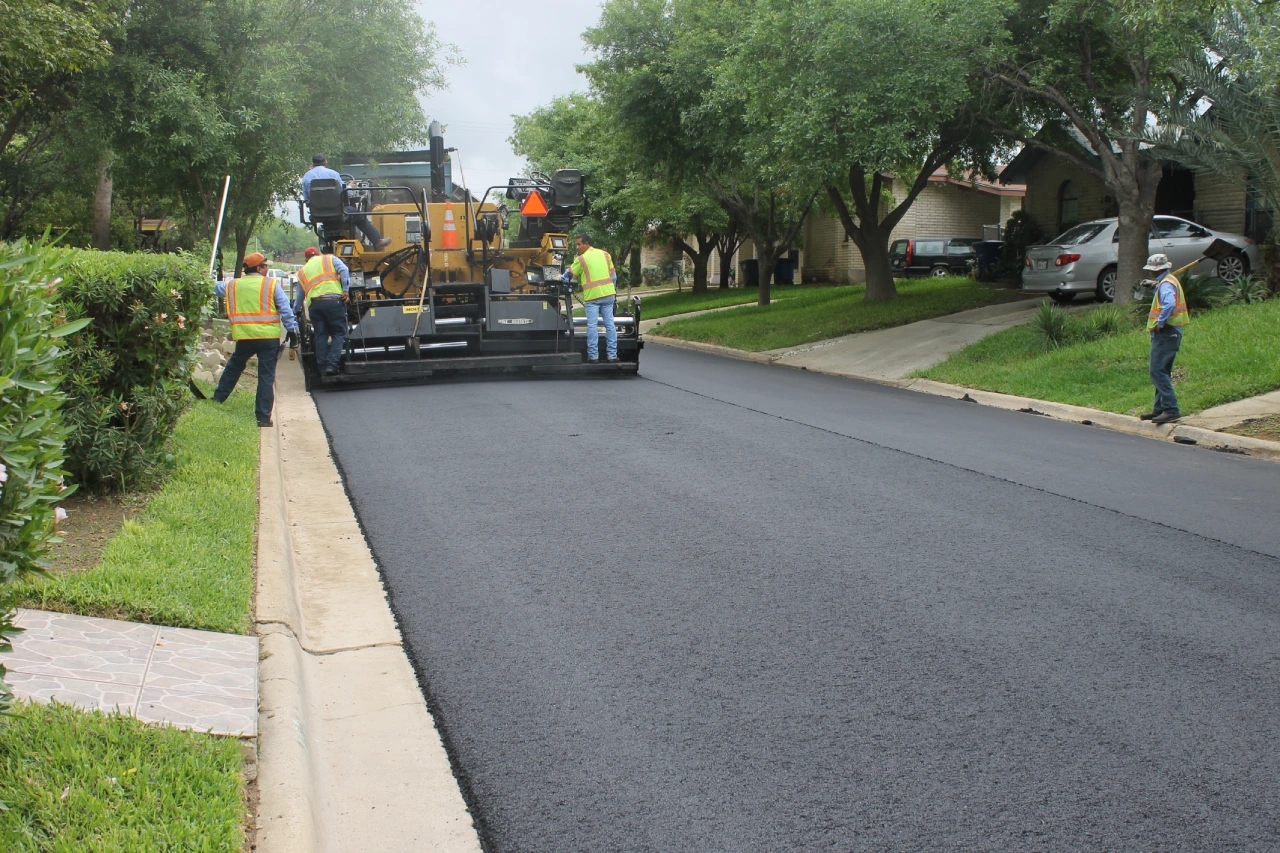
Industrial paving project phasing can be just as important as the pavement work itself. Warehouses, distribution centers, manufacturing sites, and industrial campuses may need to remain active while construction is underway.
A practical phasing plan may consider:
Truck circulation and delivery routes, loading dock access, employee and visitor traffic, temporary closures, emergency access, traffic control, staging areas, project sequencing
The goal is to coordinate construction around essential site operations where conditions allow, rather than treating the property as though it can simply shut down.
When Does a Property Need an Industrial-Grade Paving Approach?
A property may need a heavier-duty approach when the same routes regularly carry loaded trucks, trailers, fleet vehicles, or industrial equipment. The decision should be based on actual use, not simply whether the property is labeled “industrial.”
A facility with occasional delivery trucks may have different needs from a high-volume logistics center. Similarly, a standard commercial approach can sometimes serve mixed-use areas effectively when traffic demands are modest, and the pavement structure matches the site.
The most useful questions are:
What vehicles use the roadway? How often do they travel it? Where do they turn, stop, or queue? Are there existing drainage or base problems? Must the site stay active during construction? What pavement failures are already visible?
Those answers help define whether a standard commercial approach is appropriate or whether a more demanding industrial solution should be evaluated.
Planning for Long-Term Industrial Pavement Performance
Industrial Roadway Paving differs from standard commercial work because traffic loads, site support, drainage, compaction, and facility operations can all carry more weight in the planning process.
Adams Asphalt & Construction has served Kent and the Greater Puget Sound region since 1971. For industrial or commercial properties with roadway, grading, drainage, or related site needs, AAC can assess existing conditions and discuss construction options that fit the actual project scope.
A site evaluation is especially useful when heavy traffic, recurring failures, drainage issues, or operational constraints make the right solution unclear.
Frequently Asked Questions For Industrial Roadway Paving
Can asphalt handle repeated semi-truck traffic?
Yes, when the pavement system is appropriate for the expected loads and site conditions. Performance depends on more than the surface course. Subgrade support, base condition, drainage, compaction, materials, and the frequency and location of heavy vehicle movements all matter.
Is industrial pavement always thicker than commercial pavement?
Not necessarily. Thickness depends on project-specific traffic, soil support, base construction, drainage, materials, and specifications. A heavier-use area may require a different pavement section, but a universal thickness rule is not technically responsible.
Why do truck lanes develop ruts?
Rutting can result from repeated loading, material deformation, insufficient support, moisture-related weakening, or a combination of factors. Because the visible depression does not identify the cause by itself, the pavement and supporting layers should be evaluated before selecting a repair.
Can an industrial facility stay open during paving?
Often, work can be sequenced to preserve some access, but the options depend on site layout, safety, project scope, truck routes, loading needs, and reopening requirements. Early coordination helps identify which areas can be closed or phased without unnecessary disruption.
When is an overlay not enough?
An overlay may be unsuitable when significant base failure, unstable subgrade, severe deformation, or unresolved drainage problems are present. The existing pavement condition should be assessed first so the recommended work addresses the cause rather than only covering the symptom.